• Skip to primary navigation
  • Skip to main content

Myoksha Travels

Powered by The Temple Girl

  • Temple Tours
  • Jyotirlinga in Maharashtra
  • Dwarka Somnath Tour
  • Char Dham Yatra 2026
  • Panch Dwarka Temples
  • Jyotirlinga in India
  • Contact Us

Sasidhar Darla

Mahad Ganpati Temple Ashtavinayak Guide-Timings, Poojas and Significance

August 19, 2019, Sasidhar Darla 1 Comment Filed Under: Maharashtra Temples Tagged With: Ashtavinayak Temples, Ganesha Temples

Mahad Ganpati Varad Vinayak Temple is dedicated to the Hindu deity Lord Ganesh and is one of the Eight Ashtavinayak Temples of Pune in Maharashtra. The temple is in Mahad village, Raigad district. Subhedar Ramji Mahadev Biwalkwar built the Mahad Ganpati Temple in the year 1725.

Planning to visit this temple? Have a look at our Ashtavinayak Yatra Tour Packages.

Mahad Ganpati Temple – Facts

Deity Lord Ganesh
Location Mahad, Maharashtra
Significance Part of Ashtavinayak Temples
Best Time to Visit July – November
Darshan Timings 5:30 AM to 09:00 PM
Entry Fees Free
Vehicle Parking Fees Free parking space available
Photography Not Allowed
Dress Code Traditional
Festivals Badrapat Sudh, Magh Sudh, and Ganesh Jayanti
Mahad Ganpati Temple tour in a short video

Devotees who pay a fee of INR 31,000 have an opportunity to worship the Lord for the entire day. Moreover, no priests or officials will interrupt the devotee during his prayers.

Timings and puja of Mahad Ganpati Temple

Puja and Rituals at Mahad Ganpati Temple
Devotees lining up for Puja and Rituals at Mahad Ganpati Temple
Timings From
Darshan Starting Time 5.30 AM
Temple Closing Time9 PM
Panchamrit puja 8 AM
Sahastravartan Puja
Ekadashan

Mahad Ganpati Temple performs rituals on behalf of devotees. The priest offers Holy ash and Prasad to devotees who do the rituals.

What is the significance of Mahad Ganpati Temple?

The significance of the Mahad Ganpati temple is that the Varad Vinayak idol is self-manifested. The Lord’s idol was found immersed in a lake in the year 1690 by a Ganesh devotee named Paundkar. Devotees can come into the sanctum sanctorum and directly worship the Lord at Mahad Ganpati Temple.

  • The Varad Vinayak idol at Mahad Ganpati Temple faces east and the trunk is turns left.
  • Lord Varad Vinayak at Mahad Ganpati Temple is accompanied by consorts Riddhi and Siddhi
  • The sanctum sanctorum had a Nandadeep or a perpetual oil lamp, which is believed to burning continuously since 1892
  • Further, Mahad is a scenic village and offers an excellent ambiance for people who wish to meditate
  • Gagangiri Maharaj, a spiritual leader did penance on the water of a nearby dam
  • According to beliefs, Gritsamada created the Ganana Twam. The mantra is a very powerful chant when praying to Lord Ganesh.

The idol at the Varad Vinayak Mahad Ganpati Temple is Swyambhu and the temple is actually recognised as a Math.

Idol of Lord Ganesh at Mahad Ganpati Temple
The divine idol of Lord Ganesh that can be seen inside the sanctum of Mahad Ganpati Temple.

Legends and History of Mahad Ganpati Temple?

The history attached with Mahad Ganapati temple relates to the following legend:

Legend of Varad Vinayak: During his hunting trip, Prince Rukmaganda of Koudinyapur stopped at Rishi Vachaknavi’s hermitage. The Rishi’s wife Mukunda admired the handsome prince and tried to seduce him, but the righteous Prince refused. But, Lord Indra saw the plight of the lovesick Mukunda.

Therefore, he impersonated Prince Rukmaganda and fulfilled her desire. Mukunda soon gave birth to a son Gritsamada, who grew up to be a great scholar. Gritsamada was once invited to debate along with great Rishis. One of the Rishis refused to debate with Gritsamada as he was not a true Brahmin.

A surprised Gritsamada questioned his mother and learned about his birth. In a fit of anger, he cursed that she will turn into a thorny plant. Mukunda, in turn, cursed Gritsamada that he will have a demon child. When the two were cursing each other, a celestial voice said that Gritsamada was Lord Indra’s son.

A repenting Gritsamada retreated to Pushpak forest and performed penance to Lord Ganesh. Pleased with his prayers and devotion, Lord Ganesh appeared before him and granted him a boon. Gritsamada requested that he be recognized as a Brahmin and also that Lord Ganesh stay in this forest and bless the people.

Hence, Lord Ganesh granted his two wishes and stayed in the forest. So, Gritsamada called Lord Ganesh as Varad Vinayak or the Lord who grants wishes.

Scenically located this temple is adjacent to a beautiful pond and it is believed that the idol of the Lord was found immersed in the nearby lake.

The architecture of Mahad Ganpati Temple –

The temple is in all respects basically planned with a tiled rooftop. It has an arch 25 feet high with brilliant apex and a brilliant summit (Kalas) which has a beautifully carved cobra. The Temple is 8 feet long and 8 feet wide.

The first icon of Varad Vinayak can be seen outside the sanctum. Since the symbol was in a severely endured condition, the temple trustees inundated that icon and blessed another icon in that place. Be that as it may, such a choice of trustees was protested by few individuals and a suit was documented in the district court.

Presently two icons, one inside the sanctum and one outside the sanctum can be seen. The sanctum made up of stone and encompassed by flawlessly cut stone elephant carvings, houses the symbol.

A Gomukh is seen on the north side of the temple from which streams the heavenly water. A blessed lake is located on the west side of the temple. This temple additionally has the symbol of Mushika, Navagraha Devtas, and Shivalinga.

It is also believed that the person who receives a coconut as Prasadam during Maghi Chathurthi is blessed with a son.

Which festivals are celebrated at Mahad Ganpati Temple?

Ganesh Chaturthi Festival
The celebration of Ganesh Chaturthi at Marad Ganpati Temple

Some of the festivals celebrated at Mahad Ganapati Temple are:

  1. Bhadrapath: Lord Ganesh’s birth celebrations known as Ganesh Chaturthi or Vinayak Chaturthi is a key festival in the state of Maharashtra. In Mahad, Lord Varad Vinayak’s birthday is a five-day festival from Bhadrapath Shudh 1 to Bhadrapath Shudh 5 (August –September)
  2. Magh: The Magh Utsav is an important festival at the Varad Vinayak Temple. The celebrations take place from Magh Shudh 1 to Magh Shudh 6 (January – February).
  3. Shravan: Janmashtami or Krishna Ashtami, Lord Krishna’s birthday is celebrated here with a Dahi Handi event during Shravan ( July- August)
  4. Holi: The colorful festival of Holi is in the month of Phalgun (February/March), on Phalgun Shudh Poornima.
  5. Aashad: Chaturmas symbolizes Lord Vishnu’s four months slumber. The beginning of Chaturmas is in the month of Aashad (June-July). Devotees can participate in Puram Pravachan program during this period.
  6. Ashwin: Devotees celebrate the Dusshera festival here on Ashwin Shudh 10 (September/October). During the festivities, Lord Ganpati is taken on a palanquin procession across the village.

How to reach Mahad Ganpati Temple?

Map of Ashtavinayak Temples in Maharashtra
The Route Map of all the eight Ashtavinayak Temples in Maharashtra
  • Road – Mahad Ganpati Temple is 63 km from Mumbai and 85 km from Pune. Mahad enjoys good roads and several buses operate from Mumbai, Thane, and Pune.
  • Rail – The nearest railway stations are in Khopoli and Karjat. All Express Train Services halt at Karjat Station.
  • Air – The nearest airports are in Mumbai and Pune and they are equidistant to Varad Vinayak Temple. There are numerous numbers of taxis and buses that will take you to Mahad from outside the airport.

Where to stay near Mahad Ganapati Temple?

Mahad has a Bhakta Niwas or Pilgrim’s rest house with clean rooms at very nominal rates. Mahad doesn’t have any hotels, but devotees can either choose between the rest house of stay at Mumbai / Pune.

  • Varadvinayak Ganpati Bhakta Niwas is the ideal place to stay here. The rooms and loos are clean and well-maintained. Rs.200 is charged for a room and beddings are provided by the trust.

Where to eat near Mahad Ganapati Temple?

Maharastrian Cuisine
Devotees can enjoy Maharastrian Cuisine in their way to Mahad Ganpati Temple.

The Mahad Ganpati Temple offers Prasad for devotees. Villagers and priests also offer Thali meals which are pre-booked. Also, devotees who make day trips to Mahad can also choose to eat in the city of Mumbai/Pune where one can find excellent and diverse food options.

  • Lunch is provided as prasad by the temple (noon-2 pm).
  • Else, villagers (temple officials guide visitors to them) provide good meals for Rs 40 per thali.

What are the sightseeing places near Mahad Ganapati temple?
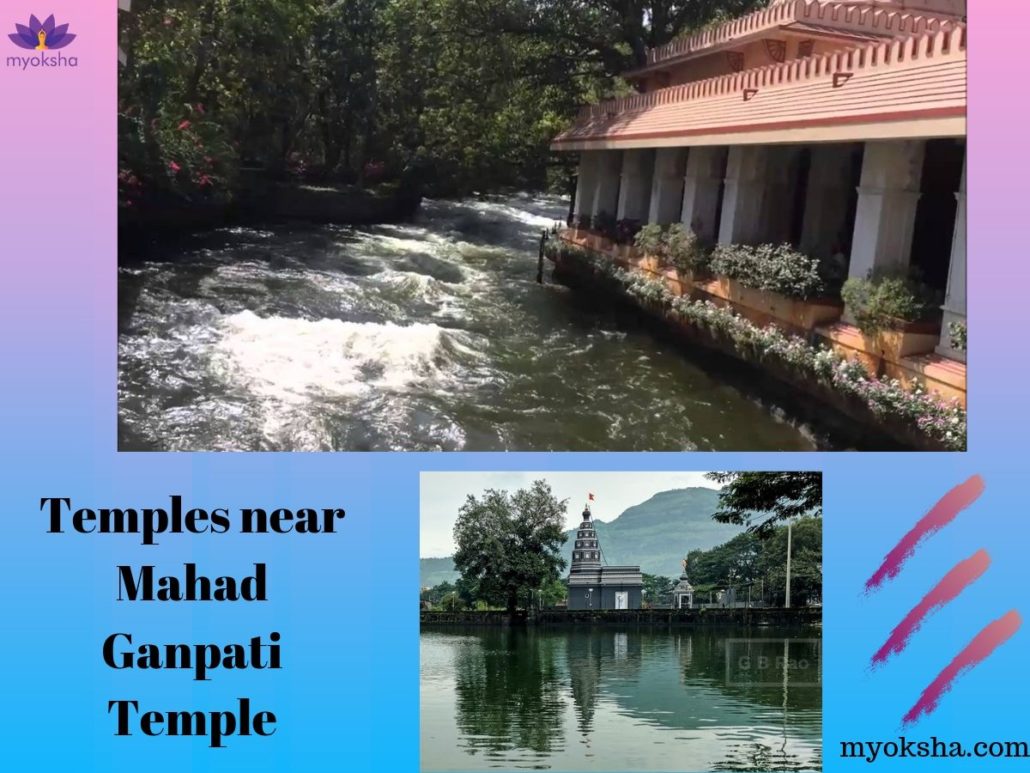
Temple near Mahad Ganpati Temple
Devotees who visit Mahad Ganpati can also travel to Khopoli to visit the temples there.

Temples near Mahad Ganapati Temple are:

  • Gagangiri Ashram, Khopoli: According to beliefs, Gagangiri Maharaj, a prominent spiritual leader did penance in Khopoli and nearby forests. He attained Samadhi at his Ashram in Khopoli which attracts devotees. The ashram is 21 km from Mahad Ganpati Temple
  • Shankar Mandir, Khopoli: Nana Phadnavis, built an oval-shaped reservoir and a temple dedicated to Lord Shiva. The temple does not have an idol, but an image which visitors worship. Mahasivarathri festival fair attracts a lot of devotees to this temple. The Shankar Mandir is 28 km from Mahad Ganpati Temple.

There are statues of four elephants on four sides of the temple that are said to guard the temple.

What are the other Ashtavinayak Temples?

Asthavinyaka temples
The divine idols of Lord Ganesh in different Ashtavinayak Temples in Maharashtra

The other Ashtavinayak temples are:

  1. Mayureshwar Temple, Morgaon – This is the first of the Ashtavinayak Temples. Devotees begin and end their journey at the Mayureshwar Temple. The temple got its name after the legend of Mayureshwar – Lord Ganesh riding a peacock.
  2. Siddhi Vinayak Temple, Siddhatek – This temple is the second in the list of Ashtavinayak Temples. Lord Vishnu is believed to have appeased Lord Ganesh at this place before slaying the demons Madhu and Kaitabh.
  3. Ballaleshwar Temple, Pali: This temple derives its name from Lord Ganesh’s devotee Ballal. This is the only Ganesh Temple whose name is after a devotee. It is in Pali, 180 km from the Girijatmaj Temple.
  4. Chintamani Temple, Theur – This temple is the fifth in the list of Ashtavinayak temples. Lord Ganesh retrieved the invaluable jewel – Chintamani from a greedy demon and gave it back to sage Kapila.
  5. Girijatmaj Temple, Lenyadri: Goddess Parvathi performed penance at this place to have a child. Her prayers were answered when Lord Ganesh was born. The temple gets its name from the words Girija (Parvathi) and Atmaj (son).
  6. Vighneshwar Vinayak Temple, Ozar – This temple is the seventh in the list of Ashtavinayak Temples. Lord Indra sent Vighnasur to disturb King Abhinandan’s prayer. Then, the troubled devotees turned to Lord Ganesh who defeated the demon at this place.
  7. Mahaganapati Temple, Ranjangaon – This is the last of the Ashtavinayak Temples. Lord Shiva worshipped Lord Ganesh here before proceeding to defeat the demon Tripurasura.

Frequently Asked Questions about Mahad Ganpati Temple –

Is there online booking available for Mahad Ganpati Temple?

Entry to the temple is free and no booking is needed to visit the temple.

Where can we stay near Mahad Ganpati Temple?

The Dharamshala or Bhakta Nivas is the best option to stay near Mahad Ganpati Temple. Also, they can be found at cheap rates.

What is the nearest airport to Mahad Ganpati Temple?

The nearest airports are in Mumbai and Pune at a distance of 63 km and 85 km.

What is the temperature in Mahad Ganpati Temple?

The maximum temperature in summer can reach till 35°C. The minimum temperature that can fall down is 13°C in winter.

What is the significance of Mahad Ganpati Temple among Ashtavinayak Yatra?

The Mahad Ganpati Temple comes in 4th number during the Ashtavinayak Yatra.

What is the prasad’s usually offered in the temple?

Ladoo and Modak prasad which are known to be favorite of Lord Ganesh are offered in the temple.

How do devotees pray in the Mahad Ganpati Temple?

Devotees can offer prayers in the Garbhagriha of Mahad Ganpati temple. Flowers, Garlands are the main offerings made at Mahad temple.

Ballaleshwar Pali Ganpati Temple Guide – Ashtavinayak – Timings, Poojas, and Significance

August 19, 2019, Sasidhar Darla 1 Comment Filed Under: Maharashtra Temples Tagged With: Ashtavinayak Temples, Ganesha Temples

Pali Ganpati Temple, also popular as Ballaleshwar Temple is dedicated to Lord Ganesha and is one of the eight Ashtavinayak Temples of Pune in Maharashtra. The temple is in Pali village, Raigad district. Moreover, it is the only temple dedicated to Lord Ganesha named after his devotee.

Planning to visit this temple? Have a look at our Ashtavinayak Yatra Tour Packages.

Ballaleshwar Pali Ganpati Temple – Facts

Deity Lord Ganesha
Location Pali, Maharashtra
Significance Part of Ashtavinayak Temples
Best Time to Visit July – November
Darshan Timings 5:30 AM to 10:00 PM
Entry FeesFree
Vehicle Parking Fees Free
Dress Code Traditional
Festivals Bhadrapat, Magh Utsav, Shree Dhundi Vinayak Utsav, and Ganesh Chathurthi
https://www.youtube.com/watch?v=qnyVcDEeZFE
Ballaleshwar Pali Ganpati Temple Puja and Aarti

Ballaleshwar Pali Ganpati Temple – Timings

The timings for Pali Ganapati Temple are:

TimingsFromTo
Regular Temple Timings5:30 AM10:00 PM
Inner Sanctum Timings 5:00 AM11:30 AM
Outer Sanctum Timings5:00 AM10:30 PM
Sankat Chaturthi Timings6:00 AM9:00 AM

Men should wear dhotis to perform pooja in the sanctum of Ballaleshwar Pali Temple.

Which Sevas and Poojas are performed at Ballaleshwar Pali Ganpati Temple?

The following Poojas and Sevas are taken place at Pali Ganapati Temple:

PoojasPooja Cost
Abhishek Rs. 21/-
Dugdhabhishek Rs. 101/-
Maha Pooja Rs. 251/-
Shastra Awartan Rs. 501/-
Varshik Puja Rs. 551/-
Laghurudra Awartan Rs. 751/-
Abhishek Puja (bathing the idol with milk & offering honey, fruit, etc) Rs. 25/-
Puja Ekadasi  Rs. 51/-

Flowers, Garlands, Modak, Besan laddo are the main offerings at Ballaleshwar Pali Ganpati Temple.

What is the significance of Ballaleshwar Pali Ganpati temple?

Ganpati Idol in Ballaleshwar Pali Ganpati Temple
The divine idol of Lord Ganpati inside the sanctum of Ballaleshwar Pali Ganpati Temple

The significance of Pali Ganpati Temple is that it faces east and is perfectly planned to ensure that the rays from the winter solstice’s rising sun fall directly on the main idol. The temple has two sanctums – the inner sanctum measuring 15 feet and the outer sanctum measuring 12 feet.

A devotee by name Krishnaji Narayan Pinge constructed eight pillars in 1910. The pillars are in the front of the temple and symbolize the eight directions. Lord Ballaleshwar’s idol is 3 ft tall and resembles the shape of a nearby mountain. Moreover, he is accompanied by his consorts Riddhi and Siddhi on either side.

The Dhundi Vinayak has a separate shrine and is one of the rarest idols to face west. Devotees worship the Dhundi Vinayak first. Also, the Pali Ganpati temple structure is of concrete with molten lead. Visitors can also see some of the construction equipment such as the churning wheel. The temple also includes two beautiful lakes.

A unique occurrence is said to take place on the 4th day of Bhadrapa, when Maha Bhog is offered to the temple’s deity, it is believed that the imprint of the deity’s fingers can be seen on the offerings.

What is the architecture of Ballaleshwar Pali Ganpati Temple?

Architecture of Ballaleshwar Pali Ganpati Temple
The present temple was built by Shree Phadnis of Moradabad and has a unique designing style that portrays the word श्री (Shree)

The present temple’s development work is said to have been finished by Shri Phadnis of Moradabad. It was built in a way that the word श्री (Shree) would form and face the east so that the beams of the Sun would fall legitimately on the god. The primary fascination of this temple is the 15-foot high sanctum.

There are two Sanctums (Girbhagriha) in the temple. Internal sanctum is very huge and is 15 feet high. External sanctum is 12 feet high and it has a rat icon with a Modak in his grasp and facing Lord Ganesh. The Temple walls are made very solid by blending lead with concrete while construction.

Corridor of the temple is 40 feet long and 20 feet broad and it was built by late Shri Krishnaji Ringe in 1910 A.D. The Hall is extremely wonderful with 8 columns resembling Cyprus royal throne tree. The temple’s crest also known as Kalas is enhanced with a brilliant golden sheet which was offered by donations from devotees.

  • The huge metal bell of the temple that was made in Europe.
  • The Palakhi utilized for the procession is additionally covered with silver plates. This likewise has originated from donations by devotees.
  • The bathing utensils of Lord Ganesha like circular pot known as the Ghangal and sitting device the Chaurang, upper arms of the icon and focal hanging the Zumber are covered completely with silver plates.
  • Gold and silver crowns can be seen adorning the icon and fish, which are also offered by devotees.

After vanquishing the Portuguese in Vasai and Sasthi, Chimaji Appa brought these bells and offered them at various Ashtavinayak places.

What is the history of Ballaleshwar Pali Ganpati temple? 

The history of the Pali Ganpati Temple is that it is believed to be originally built in the 11th century. Moreshvar Vitthal Sindkar contributed to the construction of the temple in 1640. Also, it was originally made of wood and was renovated in the year 1760 by Moropant Dada Phadnavis.

Legend of Balleleshwar: According to Ganesh Puran, Kalyansheth was a successful businessman in Pallipur. His son Ballal was a devout child who spent most of his time praying and worshipping Lord Ganesh. Then, one day he invited all the children from his village for a special Pooja.

Ballal and his friends kept one large stone and worshipped it as Lord Ganesh. However, the children were so engrossed in their prayers that they did not return home for days. This irritated the villagers who complained to Kalyansheth. Then he came to the Pooja and destroyed the stone and tied Ballal to a tree as punishment.

Ballal cried and prayed to Lord Ganesh who appeared before him as a Sadhu. Ballal identified the Sadhu as the Lord himself and asked for his blessings. He also requested the Lord to always be with him and stay in this place. Hence, Lord Ganesh embraced Ballal and vanished into a stone. Then this stone became the Lord Ballaleshwar idol.

Legend of Dhundi Vinayak: The large stone which Ballal’s father Kalyansheth threw to the ground was known as Dhundi Vinayak. This is believed to be self-manifested or Swayambu and is worshipped before Lord Ballaleshwar.

It is customary to first pray at the Dhundi Ganapathy temple which is just before the main temple.

Which festivals are celebrated at Ballaleshwar Pali Ganpati Temple?

Ganesh Chaturthi Festival
Ganesh Chaturthi is one of the major festivals in Ballaleshwar Pali Ganpati Temple

Some of the festivals celebrated at Pali Ganapati Temple are:

  1. Bhadrapath: Lord Ganesh’s birth celebrations known as Ganesh Chaturthi or Vinayak Chaturthi is a key festival in the state of Maharashtra. Moreover, in Pali, Lord Ballaleshwar’s birthday is a five-day festival from Bhadrapath Shudh 1 to Bhadrapath Shudh 5 (August – September)
  2. Jeshath: Similar to Bhadrapath, the Dhundi Vinayak Utsav is a five-day festival from Jeshath Shudh 1 to Jeshath Shudh 5 (May – June)
  3. Shravan: Janmashtami or Krishna Ashtami, Lord Krishna’s birthday is celebrated here with a Dahi Handi event during Shravan ( July- August)
  4. Holi: The colorful festival of Holi is in the month of Phalgun (February/March), on Phalgun Shudh Poornima.
  5. Aashad: Chaturmas symbolizes Lord Vishnu’s four months slumber. The beginning of Chaturmas is in the month of Aashad (June-July). Devotees can participate in Puram Pravachan program during this period.
  6. Ashwin: Devotees celebrate the Dusshera festival here on Ashwin Shudh 10 (September/October). During the festivities, Lord Ballaleshwar is taken on a palanquin procession across the village.
  7. Kakad Aarti: The priest performs a special Kakad Aarti at 5:00 am before Lord Ballaleshwar from Ashwin Vadhya 1 to Karthika Shudh Poornima.
  8. Magh: The Magh Utsav is an important festival at the Ballaleshwar Temple.  Here, the celebrations are held from Magh Shudh 1 to Magh Shudh 6 (January – February). During this period, devotees conduct Bhajans, Kirtans and several programs.

Where to stay near Pali Ganapati Temple?

Places to stay near Ballaleshwar Pali Ganpati Temple
The Ballaleshwar Temple charitable trust also runs a Dharamshala or Bhakta Nivas for devotees to stay.

Since Pali is a well-known pilgrimage site, several accommodation options are available to meet the needs of pilgrims. Moreover, the Ballaleshwar Temple charitable trust also runs a Dharamshala or Bhakta Nivas and provides accommodation at a nominal cost. There are 2 options for accommodation in the Bhakti Nivas with 24 Rooms & 2 Halls.

  • In Bhaktnivas No 1 there are a total of 10 rooms available for the devotees. The room charges being Rs.250/- for 5 persons in 1 room.
  • In Bhaktinivas No.2 there are 14 Rooms for the devotees to stay. The room charges being Rs.300/-.
  • For lodging in the hall accommodation, the devotees have to pay a minimal charge of Rs.10/- per person.

How to reach Pali Ganpati Temple?

Map of Ashtavinayak Temples in Maharashtra
The Route Map of all the eight Ashtavinayak Temples in Maharashtra

Here’s how to reach Pali Ganapati Temple:

  • Road – Pali enjoys good roads and several buses operate from Mumbai, Thane, and Pune. The RedBus operates a bus from Mumbai to Ballaleshwar Pali in every 15 minutes. Devotees can get the Tickets at a minimal cost of ₹550 – ₹750 and the journey takes 3h.
  • Rail –  Nearest railway stations are in Khopoli and Karjat. Several buses operate from these stations to Pali. The Indian Railways operates a train from Mumbai to Ballaleshwar Pali once daily. Devotees can purchase the Tickets at ₹150 – ₹1,000 and the journey takes 2h 43m.
  • Air – The nearest airports are in Mumbai and Pune at a distance of 105 km and 127 km respectively. There are numerous numbers of taxis and buses that will take you to Pali from outside the airport.

Where to eat near Pali Ganapati Temple?

Maharastrian Cuisine
Maharashtrian cuisine is extremely popular near Pali Ganpati Temple

There are several eateries and restaurants in and around Pali. Devotees also partake the food provided at the Ballaleshwar Temple.

Devotees can also get a meal coupon from the temple office (timing: till 1.30p.m.) for Rs.10/-. 

The twin forts of Sarasgad and Sudhagad, from the era of Chhatrapati Shivaji, are popular trekking destinations.

What are the sightseeing places near Pali Ganapati temple?

Sightseeing Places near Ballaleshwar Pali Ganpati Temple
The Sudhagad Fort and the hot springs of Uddhar are few of the places to explore near Ballaleshwar Ganpati Temple in Pali

Here’s a list of some temples and attractions near Pali Ganapati temple:

  1. Sudhagad Fort: The Sudhagad Fort houses a shrine dedicated to Goddess Bhorai. Bhrigu Maharishi installed the shrine. The Sudhagad Fort is 15 km from the Ballaleshwar Temple.
  2. Gramdevata Vardayini Temple, Usar: Goddess Vardayini blessed Lord Rama at this place. This temple is 9 km from the Ballaleshwar Temple.
  3. Uddhar: This is the place where Lord Rama’s devotee, Jatayu had fought Ravana after he had abducted Sita. The place has hot springs and also a pond. Also, the water from the pond has the ability to dissolve bones and devotees perform Asthi Visarjana here. Uddhar is 14 km from the Ballaleshwar Temple
  4. Siddheshwar Temple: The Siddheshwar Temple is for Lord Shiva and houses a Linga. Moreover, the temple is over 350 years old and is 3 km from Pali.

What are the other Ashtavinayak Temples?

Asthavinayak Temple
Different Idols of the Ashtavinayak Temples in Maharashtra

The other Ashtavinayak Temples are:

  1. Mayureshwar Temple, Morgaon – This is the first of the Ashtavinayak Temples. Devotees begin and end their journey at the Mayureshwar Temple. The temple got its name after the legend of Mayureshwar – Lord Ganesh riding a peacock.
  2. Siddhi Vinayak Temple, Siddhatek – This temple is the second in the list of Ashtavinayak Temples. Lord Vishnu is believed to have appeased Lord Ganesh at this place before slaying the demons Madhu and Kaitabh. The Siddhi Vinayak Temple is in Siddhatek, Maharashtra.
  3. Varadha Vinayak Temple, Mahad – This temple is the fourth in the list of Ashtavinayak Temples. Lord Ganesh is famous as Varadha Vinayak, the Lord who grants boons and wishes.
  4. Chintamani Temple, Theur – This temple is the fifth in the list of Ashtavinayak temples. Lord Ganesh retrieved the invaluable jewel – Chintamani from a greedy demon and gave it back to sage Kapila.
  5. Girijatmaj Temple, Lenyadri – This temple is the sixth in the list of Ashtavinayak Temples. Goddess Parvathi performed penance at this place to have a child. Then her prayers were answered when Lord Ganesh was born. So, the temple gets its name from the words Girija (Parvathi) and Atmaj (son).
  6. Vighneshwar Vinayak Temple, Ozar – This temple is the seventh in the list of Ashtavinayak Temples. Lord Indra sent Vighnasur to disturb King Abhinandan’s prayer. Then, the troubled devotees turned to Lord Ganesh who defeated the demon at this place.
  7. Mahaganapati Temple, Ranjangaon – This is the last of the Ashtavinayak Temples. Lord Shiva worshipped Lord Ganesh here before proceeding to defeat the demon Tripurasura.

Frequently Asked Questions about Pali Ganpati Temple –

Is there online booking available for Chintamani Ganpati Temple?

Entry to the temple is free and no booking is needed to visit the temple.

Can I drive from Mumbai to Ballaleshwar Pali?

Yes, the driving distance between Mumbai to Pali Ganpati Temple is 104 km. It takes approximately 1h 25m to drive from Mumbai to Pali.

Where can we stay near Ballaleshwar Pali Ganpati Temple?

There are more than 25+ hotels available in Ballaleshwar Pali route. The prices start at ₹3,000 per night. Moreover, there are Dharamshala or Bhakta Nivas that can be found in cheap rates.

What is the cheapest and easiest way to get from Mumbai to Ballaleshwar Pali Ganpati Temple?

The cheapest and easiest way to get from Mumbai to Pali Ganpati Temple is to drive which costs ₹750 – ₹1,200 and takes 1h 25m.

What is the nearest airport to Ballaleshwar Pali Ganpati Temple?

The nearest airports are in Mumbai and Pune at a distance of 105 km and 127 km.

What is the temperature in Ballaleshwar Ganpati Temple, Pali?

The maximum temperature in summer can reach till 35°C. The minimum temperature that can fall down is 13°C in winter.

Where is the Dhundi Vinayak Temple situated?

The Dhundi Vinayak Temple is situated behind the main temple of Ballaleshwar Pali Ganpati Temple.

What is the significance of Dhundi Vinayak Temple?

The idol in this temple is believed to be Swayambhu. The idol of Dhundivinayak faces west. Devotees first visit this temple before going to the main temple.
 

Rameswaram Ramanathaswamy Temple Guide – Timings, Poojas, and History

August 2, 2019, Sasidhar Darla 19 Comments Filed Under: Jyotirlinga, Tamil Nadu Temples Tagged With: Shiva Temples

Rameswaram Ramanathaswamy Temple in Tamil Nadu is dedicated to Lord Shiva. The temple is one of the 12 Jyotirlinga Temples in India. It is located in the Rameshwaram District of Tamil Nadu, the southernmost part of India.

Planning to visit the Rameswaram Temple? Have a look at our Madhurai Rameswaram Tour Package.

Rameshwaram Temple – Facts

DeityLord Rameshwar (Lord Shiva)
LocationRameshwaram, Tamil Nadu
SignificanceJyotirlinga
ToursMadurai Rameswaram Tour
Darshan Timings6:00 AM to 9:00 PM
Entry FeeFree
PoojasRudrabhisek, Laghurudrabhisek
Best Time to VisitOctober to March
FestivalsShravan, Shivratri
Jyotirlingas in South IndiaRameswaram Temple, Srisailam Temple
Rameswaram Ramanathaswamy Temple Video

What are the timings of Rameswaram Temple?

The temple opens at 6 AM and closes at 9 PM. The temple also performs various rituals during this time. The devotees can be a part of these rituals, such as the morning, afternoon, and evening poojas.

The timings are as follows:

RitualFromTo
Morning Darshan6:00 AM1:00 PM
Evening Darshan3:30 PM8:30 PM
Rameshwaram Shiva
The Rameswaram Ramanathaswamy Temple is closely associated to Lord Rama.

What are the sevas and poojas of the Rameswaram Temple?

Poojas at Rameswaram
There are several poojas that take place at the Rameswaram Ramanathaswamy Temple.

Some of the sevas and poojas of the Mahakaleshwar Temple are:

RitualTimings
Palliyarai Deepa Arathana5:00 AM
Spadigalinga Deepa Arathana5:10 AM
Thiruvananthal Deepa Arathana5:45 AM
Vila Pooja7:00 AM
Kalasanthi Pooja10:00 AM
Uchikala Pooja12:00 PM
Sayaratcha Pooja6:00 PM
Arthajama Pooja8:30 PM
Palliyarai Pooja8:45 PM

The Palliyarai (Sayanangriha) Procession of Swami and the Palliyarai Pooja for Swami and Ambal in the Sayanagriha in the Ambal Shrine are performed between 8:45 PM and 9:00 PM.

Some famous poojas conducted at the Rameswaram Ramanathaswamy Temple are:

  • 1008 silver Kalasa Abishekam
  • 108 silver Kalasa Abishekam
  • 1008 Kalasa Abishegam (copper)
  • Rudrabishekam
  • Panchamirtha Abishekam
  • Gangabishekam with Ganges & Vessel
  • Swami Sahasranama Archana
  • Ambal Sahasranama Archana
  • Rudrajapam
  • Swami Astothra Archanai
Rameswaram Poojas
All the poojas at the temple are celebrated with great pomp and fare.

What is the significance of Rameswaram Temple?

Rameshwaram Jyoritlinga
Like all the 12 Jyotirlingas, the Rameshwaram Jyoritlinga is Swayambhu.

The significance of Rameswaram Ramanathaswamy Temple is that the sanctum sanctorum of the temple has 2 Lingas – the Ramalingam – made out of sand by Sita, and the Vishwalingam – brought by Hanuman. Since Hanuman had brought the Linga all the way from Kailash, Lord Rama instructed that one should worship Vishwalingam first.

The entire island of Rameshwaram and nearby areas are in relation to Lord Rama. As per beliefs, many incidents from the Ramayana happened here and therefore, this place is important for both Shaivites and Vaishnavites. Rameshwaram has many as 50 Teerths or holy wells, and 22 of them are inside the temple. The water from these wells is believed to possess medicinal properties. Also, as per belief, the water from each Teerth tastes different and offers various remedies.

The Linga is made of Spatika. It is auspicious to bathe the Linga with the water from the Ganges. Devotees who go to Kashi, make it a point to bring the Ganges water and offer it to the Linga here.

The official website of the Rameswaram Ramanathaswamy Temple is: http://www.rameswaramtemple.tnhrce.in/

What is the history of Rameswaram Ramanathaswamy Temple?

Rameswaram Ramanathaswamy History
Lord Ram and Goddess Sita made a Shiva Lingam out of sand and water.

The history of Rameswaram Ramanathaswamy Temple dates back to the Ramayana period. Devotees believe that Lord Rama made the Linga and installed it here. As per the legend, Lord Rama and his wife Sita were returning from Lanka after killing Ravana, who was half-demon and half Brahmin.

Since killing a Brahmin is a sin, Lord Rama wished to worship Lord Shiva and ask his pardon. So, he had sent Lord Hanuman to Mount Kailash to bring Lord Shiva’s idol. Meanwhile, Lord Rama and Sita were living on the island and when they tried to drink the water, a powerful and divine voice spoke to them.

The voice chided Lord Rama that he was drinking the water without worshiping. Therefore, instead of waiting for Hanuman’s return, Lord Rama instructed Sita to make a Linga with the sand and water from the seashore.

Then he worshipped Lord Shiva in this form and pleaded for mercy. Lord Shiva manifested himself as the Jyotirlinga, blessed Lord Rama and also accepted to stay here and bless mankind forever. Since Lord Rama worshipped the Linga, the Jyotirlinga was named as Ramanathaswamy, and the place was called as Rameshwaram.

What is the structure of Rameswaram Temple?

Architecture of Rameswaram Ramanathaswamy Temple
The architecture of the Rameswaram Ramanathaswamy Temple is dedicated to a host of gods and goddesses carved on the walls of the temple.

The rulers of Pandya Dynasty expanded the temple in 12th century AD.

The Rameswaram Ramanathaswamy Temple has the world’s largest temple corridor. They measure around 1220 meters and also comprises of nearly 1200 magnificent granite pillars in total.

What are the festivals celebrated at Rameshwaram Temple?

Some of the festivals celebrated at Rameswaram Ramanathaswamy Temple are:

  • Mahashivratri: This festival is in honor of Lord Shiva. Devotees believe that he is the Adiyogi who is the source of the Yogi tradition. Also, people observe it by remembering Shiva and chanting prayers, fasting, doing Yoga as well as meditating.
  • Ramalinga Prathishtai: It is a 3-day festival celebrating the installation of the Ramalingam. The festival occurs during May- June.
  • Thirukalyanam: It is the celestial wedding ceremony of Lord Shiva and Goddess Parvati. The festivities carry on for a fortnight and occur in July – August.
  • Navaratri & Dussera: It is a 10-day festival celebrated in September – October.
  • Aarudhira Dharshan: It is an important day in the Shaivite calendar when Lord Shiva indulges in a cosmic dance. Also, Lord Shiva’s avatar, Lord Nataraja, performs this ecstatic dance on a day that coincides with the longest night of the year. This festival occurs during the end of December or in early January.

How to reach the Rameswaram Temple?

Here’s how to reach Rameswaram Ramanathaswamy Temple:

  • Air: The nearest airport is in Madurai, which is 174 km from Rameshwaram.
  • Train: Rameshwaram Railway station is the nearest railhead, 1 km away from the temple.
  • Road: This major pilgrim site is connected to all cities and towns in Tamil Nadu. Several state-run and private buses are available.

Where to stay near Rameswaram Ramanathaswamy Temple?

There are several accommodation options available at Rameswaram. The temple also offers accommodation options. One can also find comfortable rooms and dormitories in the TTDC Guest House at a nominal tariff.

What are some temples near Rameswaram Ramanathaswamy Temple?

Explore Rameshwaram
There are several beautiful places to visit near the Ramanathaswamy Temple, such as, the Ram Setu.

Some of the temples near Rameswaram Ramanathaswamy Temple are:

  • Satchi Hanuman Temple: The Satchi Hanuman Temple is a spot of great significance in the Ramayana. It is the place where Hanuman conveyed to Lord Rama, that Sita is in Lanka. Moreover, Hanuman gave Sita’s jewel as evidence or Satchi and hence, the spot became popular as Satchi Hanuman Temple. The temple is 3 km from Rameshwaram Ramanathaswamy Temple.
  • Panchamukha Hanuman Temple: The Panchamukha Hanuman Temple has a majestic idol of Lord Hanuman with five faces covered in vermillion. The temple also attracts devotees who come to see the floating rocks that Lord Hanuman’s army used to build the Ramsethu bridge between Indian and Sri Lanka. Also, the Panchamukha Hanuman Temple is 2 km from the Rameshwaram Ramanathaswamy Temple
  • Badrakaliamman Temple: Badrakaliamman Temple is in dedication to Goddess Durga. The temple is just 2 km away from the Rameshwaram Ramanathaswamy Temple.
  • Nambu Nayagiamman Temple: The Nambu Nayagiamman Temple is a 14th-century temple. The people of Ramnad built it as a mark of their faith and respect for Lord Rama. Further, the temple is 8 km from the Rameshwaram Ramanathswamy Temple.
  • Kothandaramaswamy Temple: This temple has relations with Vibishana, the brother of Ravana and Lord Rama. Devotees believe that Vibishana sought Lord Rama’s refuge in this place. This is also the place where Lord Rama coronated Vibishana after his victory in Lanka. The Kothandaramaswamy Temple is 12 km away from Rameshwaram Ramanathaswamy Temple.

Frequently Asked Questions about Rameswaram Temple

Is the Rameswaram Temple open throughout the year?

Yes, the Rameswaram Temple is open all 365 days of the year.

What is the entry fee?

The entry to the Rameswaram Temple is free of cost.

Is there any online darshan facility available?

No. There is no facility for online darshan available.

Is there any facility for specially-abled and senior citizen?

No. There is no facility for specially-abled and senior citizens.

What is the weather like during the summers?

The summers in Rameswaram starts from April and continue until June. The summers here can be very hot and dry. Temperatures during the daytime often go up to 45 º C.

What are winters like in Rameswaram?

In Rameswaram, winters start in October and continue until March. The temperatures during this time range from around 17 º C to 28 º C. The weather during this time is not too cold and pleasant.

Rameswaram Ramanathaswamy
The Rameswaram Ramanathaswamy is a very important pilgrimage destination.

If you have any questions about The Rameswaram Ramanathanaswamy Temple, please leave a comment below, and we will get back to you within one hour.

Dwarkadhish Temple Guide – Timings, Poojas, and History

January 24, 2023, Sasidhar Darla 30 Comments Filed Under: Dwarka Somnath Temple, Gujarat Temples Tagged With: Krishna Temples

Dwarkadhish Temple, one of the Char Dham pilgrimages, is situated in the city of Dwarka in Gujarat. Dwarka lies on the banks of river Gomti, in Saurashtra. It is historically considered as the capital of Lord Krishna. The city eventually submerged under the sea except for Temples.

Planning to visit The Dwarkadhish Temple? Have a look at our Dwarka – Somnath Tour Package and our Pancha Dwarka Tour.

Dwarkadhish Temple – Facts

DeityLord Dwarkadhish (Lord Krishna)
LocationDwarka, Gujarat
SignificanceChar Dham
ToursDwarka – Somnath Tour, Pancha Dwaraka Tour
Entry FeeFree
Darshan Timings6:30 AM to 9:30 PM
PoojasAbhishek Snan, SHringar Bhog
Best Time to VisitMarch and October
FestivalsJanmashtami, Rath Yatra, Tulsi Vivah
Jyotirlingas in GujaratSomnath Jyotirlinga, Nageshwar Jyotirlinga
Dwarkadhish Temple Video

The Somnath Temple and the Nageshwar Temple are the famous Jyotirlingas dedicated to Lord Shiva in Gujarat.

What are the timings of the Dwarkadhish Temple?

The Dwarkadhish Temple opens at 6:30 AM and closes at 9:30 PM. The temple also performs various rituals during this time. The devotees can be a part of these rituals, such as the morning, afternoon, and evening poojas. The temple remains closed from 1:00 PM to 5:00 PM.

The timings of the Dwarkadhish Temple are:

RitualFromTo
Darshan6:30 AM9:30 PM
Mangal Aarti6:30 PM –
Mangal Darshan7:00 AM8:00 AM
Shringar Aarti10:30 AM –
Sandhya Aarti7:30 PM7:45 PM

What are the sevas and poojas performed at Dwarkadhish Temple?

The temple performs the following daily poojas and sevas:

Rituals
Abhishek Snan
Uthapan (at 5 PM)
Offering of bhogs: Mangal Bhog, Makhan Bhog, Snan Bhog, and Shringar Bhog.
Offering sevas: Palna, Shayan Bhog, Paan Seva, Milk Seva, Vegetable Seva, Flower Seva, Fruit Seva and Misri Seva

What is the significance of Dwarkadhish Temple?

Dwarkadhish Temple Krishna

The significance of Dwarkadhish Temple is that Dwarka is one of the Sapta Puris in India. According to popular belief, the Dwarkadhish Temple stands over the original place of Hari – Graha, the home of Krishna. Mahabharata states that the castle of Lord Krishna was built in Gold.

The Pandavas played and spent their childhood there. This temple is also a part of the famous Pancha Dwaraka Tour.

Archaeologists have unearthed copper coins, boulders, pillars and pottery samples from the underwater excavations in Dwarka. Hence, they have concluded that a well-established city existed there in the 2nd Millennium.

Also, explorations between 1983 and 1990 show that the city consisted of six sectors. They were extended about a mile from the shore. Offshore investigations have found evidence of stone slabs, ports and other construction materials dating back to 15th Century. Hence, it supports the existence of an ancient city at the time of Lord Krishna. Further, the layout of the city mentioned in ancient manuscripts matches that of the city unearthed by The Marine Archaeology Unit of India.

The Dhwajaji – The Mast Flag atop the main Temple is unique and sacred. It is Aadhi Bhoutik in nature. The Dhwaja or the Flag is made of 52 yards of cloth. 52 small flags are woven individually in each yard of cloth. Each Yard symbolizes the entrances to the ancient city of Dwarka.

According to scriptures, 56 administrators ran the administration of Dwarka. Four of them were Lord Krishna, Balram, Pradyuma, and Anirudhji. These 4 are still worshipped in temples that are untouched by the sea. However, for the rest of the 52 people, the flag acts as a remembrance. The colours of the Dhwajaji are changed every day.

Kusheshwar Mahadev Temple

In the premises of the Dwarkadhish Temple, a small temple called Kusheshwar Mahadev Temple is present. According to a legend, Kush was a demon who lived in Kushasthali. People prayed to Lord Krishna to save them. So, Lord Krishna fought and crushed the demon. Krishna buried him completely into the ground. Hence, he set up a temple of Lord Mahadev there. The Shiva Linga lies almost 20 feet below the ground.

Dwarka Mutt

The Dwarka Mutt is one of the four mutts established by Sri Adi Shankaracharya. The others are Sringeri, Jagannath Puri, and Jyotirmath. Another name for Dwarka Mutt is Shanti Peeth. It is sacred to take a dip at the Gomati Ghat opposite to the Dwarkadhish Temple. Genuine worship at this temple washes away one’s sins.

Where is Dwarkadhish Temple

What is the history of Dwarkadhish Temple?

The history of Dwarkadhish temple is that according to Brahmi script, the temple’s first renovation was done around 100 BC. Later, Shri Adi Shankaracharya visited the temple in 800 BC and renovated it. He established the shrine of Adyashakti on the fourth floor of the temple.

Muhammad Shah attacked and destroyed the temple in 1241 AD.  Five Brahmins fought with them and died. So, the shrines near the Dwarkadhish Temple are for them. Local merchants and rulers enlarged the temple in the 15th – 16th century. And in 1965, the Pakistan Navy tried to attack the temple but failed to do so.

Another interesting legend associated with Dwarka is that of Gopi Lake. According to mythology, after leaving Mathura, Lord Krishna never went back. The Gopis of Mathura came to Dwarka to meet Krishna. After several Ras Leelas with Lord Krishna, they offered their lives to the land. Hence the name of the lake is “Gopi Talav”.

What is the story of the origin of Dwarka?

Lord Krishna’s uncle Kansa was the ruler of Mathura. His father-in-law, Jarasandha influenced him greatly. Also, Kansa terrorized and tortured the people of Mathura. Due to cruelty towards people, Krishna eventually killed him. When Kansa died, Jarasandha was furious. So, he invaded Mathura several times.

However, he was unsuccessful in annexing it. But the Yadava clan suffered huge losses and Lord Krishna decided to move them elsewhere.

Further, the story of how Krishna formed the city of Dwarka has two versions. One states that Lord Krishna flew on the Garuda and reached the Saurashtra peninsula. However, in the other version, Lord Krishna invoked Vishwakarma (Lord of Construction). He asked him to build a new city.

Vishwakarma said that it is possible to build the city if the Samudra Deva (God of Sea) gives them land. Lord Krishna worshipped the Sea God who eventually gave him 12 Yojanas of land. Consequently, Vishwakarma built the city of Dwarka for Lord Krishna.

What is the legend of Jagannath Temple?

According to the legend of Jagannath Temple, during the cremation of Lord Krishna at Dwarka, Balram and Subhadra were overcome with grief. So, they took the half-burnt body of Krishna and ran into the ocean. At the same time, King Indradyumna in Puri had a dream.

It encouraged him to visit the ocean in search of the remains of Lord Krishna.

Later, he built a gigantic temple dedicated to Lord Krishna. It is famous as the Jagannath Temple. There, he established the three wooden idols of Krishna, Balaram, and Subhadra. Also, he placed the ashes of Lord Krishna inside the wooden deity.

According to the Archeological Survey of India, the main shrine of the building is 2000 to 2200 years old. There is an umbrella-like monument in the memory of Lord Krishna to the East of Harimandir.

What is the architecture of Dwarkadhish Temple?

Dwarkadhish Temple Architecture

It has five storeys and stands on 72 limestone pillars. Also, it consists of three parts – the Prakashgarh (Nijmandir), Sabahgrah and the Shikhar. The total height of the Shikhar is 157 feet.

Furthermore, there are two Shikhars present in the Temple – the Nij Shikhar and the Ladwa Shikhar. The Nij Shikhar is five-storeyed. It houses the main deity, Lord Krishna. There are two main gates to the Dwarkadhish Temple – The Moksha Dwaar (entrance for pilgrims) and the Swarg Dwaar  (Gate to Heaven).

What are the festivals celebrated at Dwarkadhish Temple?

Some of the festivals celebrated at Dwarkadhish temple are:

  • Janmashtami: The birth of Krishna is celebrated in a very grand and spiritual way. The celebration includes a series of Poojas and rituals.  It starts right from Mangal Aarti in the morning to the Parna Rom the next day. They also perform Abhishekams throughout the day with Tulsi and Chandan.
  • Annakut Utsav: This festival is celebrated on the first day of the Kartik month. It includes preparing and offering a variety of sweets to God.
  • Tulsi Vivah: This day signifies the marriage of Lord Vishnu with Tulsi Devi. The festival starts on the 11th day of the Kartik month. It continues for 4 days.
  • Holi: The festival of colours is the favourite festival of Lord Krishna.
  • Akshaya Tritiya: The third day of the Vaisakh month is popular as the Akshaya Tritiya. The day marks the beginning of the summer season. The Idol of Lord Krishna is dressed in flowers and Chandan instead of the usual dress. Finally, the festivities end on the 11th day of the month. This day is Bhima Ekadashi.
  • Rath Yatra: On the 2nd of the Ashadh month, a representation of Lord Krishna is kept in a chariot. This chariot is then taken around the city. On this day Krishna and Balram departed to Mathura on a chariot sent by Kamsa. Also, on the same day, Krishna decided to become the Sarathi (Driver) of Arjuna’s chariot in Mahabharatha.

What is the dress code of Dwarkadhish Temple?

One should prefer formal and decent dresses while visiting the Dwarkadhish Temple. Avoid shorts, bermudas, and mini skirts.

How to reach the Dwarkadhish Temple?

Here’s how to reach Dwarkadhish temple:

  • By Air: The nearest airport is Jamnagar which is 137 km away from the temple.
  • By Rail: Regular trains are available from major cities such as Jamnagar, Rajkot, Ahmedabad, Vadodara, Surat, Mumbai, Goa, Bangalore, and Kochi.
  • By Road: Direct State Buses are available from Jamnagar, Gandhinagar, Porbandar, Rajkot, and Ahmedabad.

Where to stay near Dwarkadhish Temple?

The government runs many guest houses in the city. Some of them are Circuit House, Gayathri Athithi Grah and Birla Dharmshala where one can stay. The temple trust runs several Dharamshalas. These include Kokila Niraj Dham, Patelwadi Dharamshala, and Jay Ranchhod Dharmashala. Several private hotels are available to stay in Dwarka.

Where to eat near Dwarkadhish Temple?

Several hotels and restaurants are available near the Temple and in other parts. Mainly vegetarian cuisine is available.

What are some temples near Dwarkadhish Temple?

Explore Dwarka

Some of the temples near Dwarkadhish temple are:

  • Shri Nageshwar Temple: The Nageshwar Temple (Nagnath Temple) is 12 km away from the Dwarkadhish Temple. It is an important Shaivite pilgrimage site. This is because it is one of the 12 Jyotirlingas, the temples of Lord Shiva spread all across India. The temple is unique as the Shiva Lingam faces south and the Nandi faces east. 5 of the 12 divine Jyotirlingas are in Maharashtra.
  • Rukmini Mandir: It is 2 km away from The Dwarkadhish Temple. The Temple is for Devi Rukmini, wife of Lord Krishna. The idol of Devi Rukmini has “Chaturbhuj” or four hands. Further, each hand holds a Shanka, Chakra, Gada, and the Padma. This is so because Devi Rukmini was a reincarnation of Goddess Mahalakshmi.
  • Beyt Dwarka: The island is 30 km away from Dwarka. Also, it houses a 500-year-old temple built by Sri Vallabhacharya. The white pristine beaches at the Island are very popular for water sports and picnics.
  • Gomati Sangam Ghat: One can reach the Sangam Ghat by descending 56 steps opposite to Swarga Dwar. Also, this place signifies the junction of River Gomati with the ocean. Also, one can visit several smaller shrines dedicated to Lord Krishna and his friend Sudama.
  • Gita Mandir: The Birla family built the temple in 1970 and dedicated it to the teachings of The Bhagavad Gita. The walls of the temple contain hymns from the Bhagwad Gita.

Frequently Asked Questions about Somnath Temple

Is the Dwarkadhish Temple open throughout the year?

Yes, the Dwarkadhish Temple is open all 365 days of the year.

What is the entry fee?

The entry to the Dwarkadhish Temple is free of cost.

Is there any facility for specially-abled and senior citizens?

Wheelchair facilities for disabled and senior citizens are available at the gate of the temple. Lift facilities are also present inside the temple.

What is the weather like during summer?

The summers at Dwarka start from March and continues until June. The summers here can be very hot. Temperatures during the daytime often go up to 42 º C.

What are winters like in Gujarat?

In Dwarka, winters start in November and continue until February. The temperatures during this time range from around 12 º C to 24 º C. The weather during this time is cool and pleasant.

If you have any questions about The Dwarkadhish Temple, please leave a comment below, and we will get back to you within one hour.

Puri Jagannath Temple Guide – Timings, Poojas, and History

February 19, 2020, Sasidhar Darla 108 Comments Filed Under: Odisha Temples Tagged With: Vishnu Temples

Puri Jagannath Temple is a Vaishnavite Pilgrimage site located in Puri, Odisha. Lord Vishnu is worshipped here. It is part of the holy Char Dham Yatra. Our guide explains Puri Jagannath temple timings, history, poojas list, significance and how to travel to Puri Jagannath.

Planning to visit this temple? Have look at our Bhubaneswar Puri Konark Temple Tour.

Puri Jagannath Temple remains open daily between 05:00 am to 11:30 pm. There is an afternoon break in darshan from 01:00 pm to 04:00 pm. Prasadam timings of the temple are from 11:00 am to 01:00 pm. Required Time: 1 to 2 hours.

Puri Jagannath Temple – Facts

DeityLord Jagannath (Lord Vishnu)
LocationPuri, Orissa
ToursBhubaneswar Puri Konark Temple Tour
Dress CodeMen: Formal dress. Women: Saree or Salwar
Entry FeeFree
Darshan Timings5:00 AM to 11:30 PM
PoojasGopala Ballava Pooja, Sahanamela
Best Time to VisitOctober to February
FestivalsRath Yatra
Puri Jagannath Temple, Orissa.

Puri Jagannath Temple Timings

Puri Jagannath Temple remains open daily between 05:00 am to 11:30 pm. There is an afternoon break in darshan from 01:00 pm to 04:00 pm. Prasadam timings of the temple are from 11:00 am to 01:00 pm. Required Time: 1 to 2 hours.

The timings of the Puri Jagannath Temple are as follows:

Day Timing
Monday 5:00 am – 1:00 pm
4:00 pm – 11:30 pm
Tuesday 5:00 am – 1:00 pm
4:00 pm – 11:30 pm
Wednesday 5:00 am – 1:00 pm
4:00 pm – 11:30 pm
Thursday 5:00 am – 1:00 pm
4:00 pm – 11:30 pm
Friday 5:00 am – 1:00 pm
4:00 pm – 11:30 pm
Saturday 5:00 am – 1:00 pm
4:00 pm – 11:30 pm
Sunday 5:00 am – 1:00 pm
4:00 pm – 11:30 pm
Rituals Timings
Darshan5:00 AM – 11:30 PM
Morning Darshan5:00 AM – 1:00 PM
Afternoon Break (Temple closed)1:00 PM – 4:00 PM
Evening Darshan4:00 PM – 11:30 PM
Prasadam11:00 AM – 1:00 PM
Mangala Aarti5:00 AM – 6:00 AM
Mailam6:00 AM – 6:30 AM
Sahanamela7:00 AM – 8:00 AM
Sandhya Dhupa7:00 PM – 8:00 PM

Puri Jagannath Temple Flag Changing Time

Puri Jagannath Temple flag changing happens at 6 PM during summers and at 5 PM during winters. Every day, a new flag is tied to the wheel on the top of the temple for the devotees to witness.

Puri Jagannath Temple Dress Code

As per the Jagannath Temple dress code, men should wear formal pants and shirt. Women devotees should wear a sari or salwar kameez. Devotees will not be allowed to enter the Puri Jagannath temple wearing informal attire like jeans, shorts or T-shirts.

What is the significance of the Puri Jagannath temple?

The significance of Puri Jagannath temple lies in its idol. Unlike most idols located in other parts of the country, which are usually made of stone or metal, the idol of Lord Jagannath is made of wood. It is a popular belief that Goddess Mahalakshmi herself supervises cooking in the temple’s kitchen.

A ritual unique to the Puri Jagannath temple is the Nabakalebara process. A Neem tree is selected, cut, and an exact replica of the original idols are made out of it. Then the old idols are buried under a place called Koili Vaikuntha.

In ancient times, the Puri Jagannath temple was iconic as it gave equal importance to Vaisnavism (devotees of Vishnu), Saktism (devotees of Bhadra Kali) as well as Saivism (devotees of Shiva). Lord Jagannath represents Lord Vishnu, Balabhadra is Lord Shiva while Subhadra represents Goddess Durga.

The Shrine of Jagannath Temple
The shrine consists of Lord Balabhadra, Goddess Subhadra and Lord Jagannath, respectively.

What is the history of the Puri Jagannath Temple?

The history of Puri Jagannath dates back to many centuries. The copper plates of the Puri Jagannath Temple which were discovered belongs to the Ganga Dynasty which was then under the rule of Anantavarman Chodaganga Dev of Kalinga. In 1174E, the King Ananga Bhima Dev built the Puri Jagannath temple in its present form.

According to a story,  King Indradyumna of the Malwa had a dream that one can see Lord Vishnu in his true form in Utkala (ancient name of Orissa).

He appointed a person named Vidyapati to search for this form. Vidyapati came upon the tribal community and found out about the worshipping of the Nila Madhava and he married the daughter of the chief of the tribe. The tribals showed him the way to the place housing the Nila Madhava.

Vidyapati informed the king about the place of worship but when the King went there by himself, the Nila Madhava disappeared. Lord Vishnu, taking pity, issued a divine message to him that he should go to the shores of Puri and create the image of Lord Jagannath from a log of wood that will be floating on the waves.

Lord Vishnu appeared as a carpenter and asked to leave him undisturbed for 21 days in a room so that he could prepare the image. However, on the insistence of the Queen, the room was opened early and only the unfinished images of the three gods and the Sudarsana Chakra were present.

What is the architecture of this temple?

Puri Jagannath Architecture
The temple complex is divided into four parts.

The temple is dedicated to Lord Jagannath, Balabhadra and Subhadra. Further, it has four areas – Vimana (Sanctum), Jagamohan (Porch), Natamandir (Audience Hall) and Bhogamandap. The Vimana was once popular as the tallest structure in ancient India. On the walls, several murals depict the life of Lord Krishna.

What are the sevas and poojas performed at Puri Jagannath Temple?

The sevas and poojas performed at this temple are:

  1. Abakash: During this ritual, the astrologer of the temple announces the specific time for the day’s rituals. Also, during this time, other activities are performed such as bathing as well as brushing the teeth of the deity.
  2. Mailam: Every day, at 6 AM in the morning, the temple priests change the dresses and ornaments of the deities of the temple.
  3. Sahanamela: Pilgrims can enter the inner sanctum to have a darshan. This takes place between 7:00 AM to 8:00 AM.
  4. Gopala Ballava Pooja: Priests offer breakfast to the deities. They offer sweet popcorn (Khai), coconut sweets, ripe banana, curd, and chipped coconuts. They also perform pooja in a brief manner with Pancha Upachar only.
  5. Sakala Dhupa: Three pundits sit in front of the three deities and worships each one of them. Then they offer bhog. Puri Jagannath Temple Administration bears the cost of the rituals.
  6. Sandhya Dhupa: The aarti takes place between 7:00 PM to 8:00 PM.

What are the festivals celebrated here?

The Rath Yatra
The Puri Jagannath Rath Yatra is the world’s oldest rath yatra and is celebrated every year.

Here’s a list of festivals celebrated here:

  • Chandan Yatra: On Akshaya Tritiya, in the month of Vaisakha, devotees take the representative images of Lord Jagannath to a famous tank, Narendra Pokhari and immerse it.
  • Snana Yatra: This is the first time in a year when devotees take the deities out of the sanctum and place them on the Snana Vedi. Moreover, they dress Jagannath and Balabhadra like Lord Ganesha with an elephant head on top. They also bathe the idols with 108 buckets of water.
  • Rath Yatra: The Rath Yatra takes place in June-July every year. Devotees take the three deities to the Gundicha temple on three individual huge and magnificent raths. After 9 days, they bring back the deities to the temple in the same way. The return journey is popular as Bahuda Yatra. The three chariots are named Nandighosa for Jagannath,  Taladhvaja for Balabhadra and Devadalana for Subhadra.
  • Makara Sankranthi: This festival occurs in the Hindu month of Pausa. The day signifies the rich harvest of the agricultural produce. Prayers are given and varieties of food are also kept in front of the deities for them to bless it.

How to reach Puri Jagannath Temple?

Here’s how to reach Puri:

  • Air – The nearest airport is Bhubaneshwar which is 53 km away.
  • Train – Puri is well connected by rail. Direct trains are operated from major cities like Kolkata, Delhi, and Mumbai.
  • Road – The state buses are available in plenty from stations like Bhubaneshwar, Vizag, Konark, and Chilka.

Where to stay near Puri?

The Jagannath Temple Administration maintains two guest houses by the names of Shri Gundicha Bhakta Nivas and the Nilachal Bhakta Yatri Nivas.  One can book rooms online by visiting the site.

Private 3-star and 5-star hotels are also available in plenty for the pilgrims throughout the city of Puri.

What are some of the temples nearby?

Explore Puri
Thousands of people come to witness the famous Puri beach festival which takes place in November.

Some of the temples near Puri Jagannath are:

  • Sakshi Gopal Temple: The temple is dedicated to Lord Krishna and Radha. Amla Navami is the main festival celebrated here. The temple is located 17 km away from the Puri Highway.
  • Vimala Temple: It is located inside the Puri Jagannath temple complex. Moreover, Goddess Vimala is the consort of Jagannath and a guardian of the temple complex. Devotees pay respects to Vimala before the worship of Jagannath in the main temple. Moreover, food becomes prasad only when devotees offer it to Vimala too.  
  • Gundicha Temple: It is located 3 km away from the Jagannath temple. It is the destination of the chariots during the Rath Yatra. Further, the three deities are kept here for 7 days during the Rath Yatra.

Frequently Asked Questions

Is the Puri Jagannath Temple open throughout the year?

Yes, the Puri Jagannath Temple is open all 365 days of the year.

What is the entry fee?

The entry to the Puri Jagannath Temple is free of cost.

Is there any online darshan facility available?

No. There is no facility for online darshan available.

Is there any facility for specially-abled and senior citizen?

No. There is no facility for specially-abled and senior citizens.

Which is the best time to visit the Puri Jagannath Temple?

October to February is when winter starts in Orissa. The weather is pleasant, making it an ideal time to visit the temple.

What is the weather like during the summers?

The summers at Orissa starts from March and continues until May. The summers here can be very hot and humid. Temperatures during the daytime often go up to 45 º C.

What are winters like in Orissa?

In Orissa, winters start in October and continues until January. The temperatures during this time range from around 16 º C to 30 º C.

If you have any questions about the Puri Jagannath Temple, please leave a comment below, and we will get back to you within one hour.

  • « Go to Previous Page
  • Page 1
  • Interim pages omitted …
  • Page 52
  • Page 53
  • Page 54
  • Page 55
  • Page 56
  • Page 57
  • Go to Next Page »

Contact Us

Contact Us

  • info@myoksha.com
  • About us
  • Contact us
  • Make a Payment

Terms & Policy

  • Terms of Service
  • Privacy Policy
  • Pricing Policy
  • Cancellation Policy

Copyright © 2025 Myoksha Travels

  • info@myoksha.com
  • About us
  • Contact us
  • Make a Payment