• Skip to primary navigation
  • Skip to main content

Myoksha Travels

Powered by The Temple Girl

  • Temple Tours
  • Jyotirlinga in Maharashtra
  • Dwarka Somnath Tour
  • Char Dham Yatra 2026
  • Panch Dwarka Temples
  • Jyotirlinga in India
  • Contact Us

Blog

Vaishno Devi Temple Guide – Timings, History, and Poojas

September 25, 2019, Sasidhar Darla 12 Comments Filed Under: Jammu and Kashmir Temples Tagged With: Devi Temples

Vaishno Devi Temple is a pre-eminent dedication to Goddess Shakti (Sati or Adi Parashakti). The shrine sits comfortably among the Trikuta Mountains in Jammu and Kashmir.

Tribes of pilgrims flock to the beloved shrine battling harsh weather and a steep climb with zeal and admiration to shower themselves with her blessings.

This cave-structured temple is a place of worshipping the Goddess in the form of a five feet rock with a three-headed peak. Furthermore, the three heads locally go by the name Pindies, which are a reflection of the three holy forms of Goddess Shakti. The Pindi on the right peak represents Goddess Mahakali, the central Pindi represents Goddess Mahalakshmi and the Pindi to the left is an avatar of Goddess Saraswati.

Facts About Vaishno Devi Temple

LocationKatra, Jammu and Kashmir
Opening and Closing DatesOpen 365 days in a year
Darshan Timings5:00 am – 12:00 pm
4:00 pm – 9:00 pm
PoojaAarti before sunrise and after sunset
DeityGoddess Shakti
Nearest AirportJammu Airport
Entry FeeNo Entry Fee
Festivals Navratri
Photography in the templeNot allowed

What are the timings of Vaishno Devi Temple?

Time of the DayDuration
Morning5:00 am – 12:00 pm
Evening4:00 pm – 9:00 pm

Temple Poojas and Rituals

Pooja at Vaishno Devi Temple
Aarti takes place in both morning and evening right before sunrise and sunset

“Atma Pooja” meaning self-cleansing by the priests marks the start of the Pooja. The Goddess is then bathed with water, ghee, milk, honey and sugar. Amidst several chants and shlokas, the Goddess dresses up in a saree, chola and chuni.

The Morning and the Evening Aarti – The Aarti dedicated to the Goddess happens twice a day. Similar rituals take place once just before sunrise and once immediately after the sunset.

The whole process lasts up to two hours. Each Aarti is done once inside the main shrine or the sanctum and then outside the cave where devotees gather to witness the divine procedure.

Hereafter she is adorned with several ornaments like bangles and sindoor (kumkum). The offering of the Naivedyam is then made to the Goddess. Hereafter, the Aarti makes its way outside the cave where all the other Gods and Goddesses are worshipped.

Pooja PlaceTimings
Individual Pooja‘Yagyashaala’ in the main BhawanBefore 8:00 am at Room No.8
Shraddha Suman Vishesh PoojaIn front of the old cage of Mata’s DarbarBefore 8:00 am at Room No.8

Vaishno Devi Temple Routes – Old and New

Vaishno Devi Temple stands at one of the three peaks of the Trikuta Mountains. The 13 km Trek to the peak of the mountain starts in Katra, passes through Banganga and then diverges into two different pathways.

One route goes via the Adhkuwari Temple and is the old one to reach the Bhawan. Moreover, this route is steep and narrow but beliefs are that it is built along the original route that the Goddess took to reach the Holy Cave at the top.

However, Considering the convenience of the devotees, the administration of the temple constructed a new route. The new route is via Himkoti. This track is wide enough with an ascendable gradient. Also, most pilgrims accompanied by senior citizens and young ones prefer this route.

Banganga makes the first stop for the pilgrims on their way to the Bhawan. However, the next stops are Charan Paduka and Adhkuwari. The Adhkuwari shrine is a mark that denotes that the pilgrims are halfway through the Bhawan.

Management of Vaishno Devi Temple is quite well. And fulfils all necessary and modern requirements of its visiting pilgrims such as food, shelter, resting places, viewing points, blankets, toilets, hot water facilities and medical facilities.

Significance of Vaishno Devi Temple

  • The shrine of Mata Vaishno Devi is both popularly and controversially the most important Shakti Peetha of Goddess Sati. According to a belief, the skull or the head of the Goddess fell here after the Daksha Yagna episode. However, the other belief says it was the right arm of Goddess Sati that fell here. To support this belief, there are remains of a human hand which can still be found in the holy cave. It is popular as “Varad Hast” which means “The Hand that grants blessings”.
  • Moreover, it is a strong belief of most of the devotees that they usually receive an inner spiritual call or pull from the Mata or the Goddess to visit the Vaishno Devi shrine. Belief says that only the one who receives the call receives her blessings. Once the call comes, nothing on Earth can stop the devotee from reaching Vaishno Devi Temple.
  • The three holy Pindies here are manifestations of Goddess Shakti and arise from a single rock at the base. However, they differ from each other in aspects of colour and texture of the rock. The Pindi of Goddess Mahakali is black representing the unknown energy. Goddess Mahalakshmi’s Pindi exhibits golden yellow shade representing wealth, prosperity, and quality of life. The Pindi of Goddess Saraswati has a whitish tinge representing purity and wisdom of life.
  • Vaishno Devi Temple is the most visited pilgrimage site in the Northern half of India and it ranks second as the most visited shrine in the Tirumala Sri Venkateshwara Temple in Tirupati, Andhra Pradesh.
  • It is a local belief that any devotee who passes through the Garbha Joon (Womb shaped cave at Adhkuwari) with pure devotion ends up with his or her wish fulfilment.
  • As per the Hindu tradition, there are four Purusharth or the objectives of a good human life – Dharm (righteousness or justice), Arth (Material pursuits), Kaam (Contentment) and Moksha (Enlightenment). Beliefs are that ones who undertake the Vaishno Devi Temple pilgrimage attain all four of these. Moreover, no one goes back empty-handed from this shrine.

History of Vaishno Devi Temple

The exact date or the year of the beginning of the worship of the Goddess in the caves cannot be traced. However, several references are there in Mahabharata which hint towards the holy goddess of Jamboo Mountains.

Jamboo is the ancient name of the present-day Jammu. Beliefs are that Pandavas were the original worshipers of the Goddess in the holy cave. Five stone figures probably representing the Pandavas found in a nearby mountain range giving some credibility to the association of Pandavas to Vaishno Devi Temple.

Legends Associated with Vaishno Devi Temple

There are many legends about the temple such as –

Legend of Vaishno Devi as Trikuta

According to the legend, in the Treta Yuga, Mata Vaishno Devi was born as Trikuta to Ratnakar Sagar in South India. She later became popular as Vaishnavi as she was born from the lineage of Lord Vishnu.

At the age of 9 years, she performed penance on the seashore and met Lord Rama. She threw a marriage proposal before him. But he gave her a promise that Lord Vishnu’s tenth avatar in the Kaliyuga, Kalki will marry her.

Lord Rama gave her instructions to meditate in a cave present in the Trikuta Mountains of Jammu. He instructed her to set up an Ashram at the base of the mountains. He also gave her a bow and an arrow, a lion and a small army of monkeys for her protection.

Legend of Mata Vaishnavi and Bhairavnath

A devotee of Mata Vaishnodevi, Sridhar organized a Bhandara (Community meal) in which the villagers and Mahayogi Guru GorakshNathJi along with all his followers including Bhairavnath were sent invitations as per the goddess’s wishes. Guru Gorakshnath visited the Bhandara along with his 300 disciples including Bhairavnath.

Goddess Vaishno surprised Bhairavnath with her powers. And then he wanted to test her powers. For this, he took Shiv Avatar Guru GorakshNathJi’s permission. However, Guru Gorakshnath did not recommend it but he let Bhairavnath go ahead with his plans.

Guru Gorakshnath and all his disciples enjoyed pure vaishnav food and went off. But Bhairavnath stayed back to test her powers. Then he attempted to grab Mata Vaishnodevi and she tried her best to daunt him. On failing to do so, Mata Vaishno decided to flee away into the mountains to continue her Tapasaya undisturbed. But BhairavNath chased her to her destination.

Vaishno Devi halted at Charan Paduka, Banganga, and Adhkuwari, but she observed much to her distaste that Bhairav Nath followed her everywhere. Finally, she lost her patience and beheaded him outside the holy cave. The head of Bhairon Nath fell 1.5 km away and the site became popular as Bhairon Nath Temple today.

His soul repented the incident and asked for forgiveness from the Goddess. The Goddess forgave him and granted him the boon that the devotees will have to pay a visit to Bhairav Nath’s shrine to complete her pilgrimage.

Beliefs say that the Goddess then shed her human form and took the form of a rock to continue uninterrupted meditation.

Legend of Shridhar Pandit and Mata Vaishno Devi

The cave was unknown until about 700 years ago. In a village named Hansali, near the Trikuta Mountains, lived a Brahmin Pandit named Shridhar. He was a loyal devotee of Goddess Shakti. Goddess Shakti was happy with his devotion and gave him darshan in the form of a Kanya (young girl).

Then on her request, Shridhar invited all the villagers to his humble abode for a Bhandara (a feast of food). But seeing the crowd for the Bhandara increase Shridhar was afraid if he could accommodate them all inside his hut. Also, he worried about the food availability for all his guests.

Miraculously, the girl that gave him darshan appeared and created abundant food and space so as to fulfil everyone’s hunger.

After the Bhandara, Shridhar wanted to thank the girl but she disappeared. Hence, he spent several sleepless nights. Eventually, the Goddess gave him darshan in his dreams directing him to proceed towards the cave that was her abode.

He followed the directions that he got in his dreams and eventually discovered the cave. According to the beliefs all the three Goddesses, Mahakali, Mahalakshmi and Saraswati gave him darshan there.

Other Legends related to Vaishno Devi

Legends of Vaishno Devi
These three spots in the pilgrimage of Vaishno Devi have significant legends associated with them
  • The trek to the Bhawan begins at the Darshani Darwaza. As per beliefs, Mata Vaishno Devi met Pandit Sridhar in a child’s form right at this spot. One can also get a complete view of the Trikuta Mountain range from the Darwaza.
  • The legend of Banganga states that Goddess Vaishno Devi created the River by shooting an arrow in the ground. Hence, the name “Ban” meaning Arrow in Hindi and Ganga signifying the holy River Ganga. Creation of Banganga was to quench the thirst of a langoor called Veer who accompanied her to the holy cave.
  • The legend of the Charan Paduka states that it is where the Goddess Vaishno turned to check whether Bhairav Nath was following her or not. Her footprints got engraved on a stone at the location and are worshipped since then.
  • The Adhkuwari cave is a place where Goddess Vaishno did meditation and observed a penance devoted to Lord Shiva for nine months. This cave was womb-like in shape and hence became popular as Garbha Joon. During the meditation, she realized the presence of Bhairav Nath and created an exit route from the back of the cave with a Trishul. Devotees can still visit the cave and the Garbha Joon.

Dress Code in Vaishno Devi Temple

  • The Bhawan or the Holy Cave is 13 km away from Katra at an altitude of 5200 meters. Minimum temperatures of this region vary from -2 to 15 degree Celsius throughout the year. Hence, the region faces chilly winters almost throughout the whole year. Hence, devotees should dress in warm clothes. Jackets, scarves, socks, and shawls are a must. If travelling with children old people then take special care should be taken regarding their winter tolerance.
  • Months of December and January face heavy snowfall in the higher reaches of the mountains. Hence, blankets and proper shoes are highly advisable.
  • Also, one must carry a raincoat, especially during monsoons and winters. Walking sticks are helpful for the occasional steep climb. And devotees can avail them from the shops lining along the walking track.

Festivals celebrated at Vaishno Devi Temple

  • Navaratri – This festival dedicated to the Mother Goddess Shakti calls for a celebration at the Bhawan with great excitement and religious fever. The festivities continue for nine days. The first three days are dedicated to Durga or Kali who signifies the destruction of evil. The next three days are dedicated to Goddess Lakshmi, the deity of wealth and prosperity. The last three days are dedicated to the Goddess of wisdom, Saraswati. During this time the entire city of Katra is cleaned and decorated. Lightings of the main Vaishno Devi Complex and surrounding temples are done during Navratri. The Shobha Yatra of the Goddess is held during these nine days. Several cultural events like devotional singing competitions are held. The priests also conduct religious discourses throughout the nine days.
  • Besides Navaratri, Deepavali, Ram Navami, and Mahashivratri also call for a celebration here with great enthusiasm.

How to reach Katra?

How to reach Vaishno Devi Temple
Devotees can also take Helicopter rides to reach the holy destination
  • By Air – The nearest airport to the temple is the Jammu domestic airport. It is 75 km away from the temple. There are regular flights by several private airlines including Air India from cities like Mumbai, New Delhi, Bengaluru and Chennai to Jammu.
  • By Train – The Katra railway station was built for travellers in 2014. The station is titled ‘Shri Mata Vaishno Devi Katra’ and the IRCTC code for it is SVDK. This station is 18.9 km away from the temple. There are trains from all major cities like New Delhi, Bengaluru, Mumbai, Ahmedabad, Chennai, Pathankot, Jalandhar, Mangalore, and Kalka to SVDK.
  • By Road – Katra lies 50 km away from Jammu city. There are several luxury bus operators running regular buses between Jammu and Katra. Devotees can hire private taxies at reasonable costs. However, one can hire them outside Jammu Railway Station or the Airport.
  • The trek to the Vaishno Devi shrine begins at the Banganga Checkpost in Katra. It is a journey of about 13 km to the Bhawan at the top. Devotees can take the journey n foot, on horses, on palki (palanquin) and in a helicopter.
  • Notably, the helicopter services should be booked 60 days in advance. However, the booking can also be made at the Jagjivan Ghat near the Katra Bus Stand. Nevertheless, there are limitations to these services. And they are also subjected to cancellation due to climatic changes. Online bookings of the ticket are advised as they are subjected to easy cancellation.

Related Videos With Vaishno Devi Mandir

Obtaining “Yatra Parchi” or a “Travel Slip” at the Yatra Registration Counter near the Katra Bus Stand is a must for on-foot travellers. One can also do the booking of the slip on the temple website.

Where to stay?

  • The Shri Mata Vaishno Devi Shrine Board overlooks the maintenance of several guest houses and Dhams located in Jammu, Katra, Adkuwari, Sanjichhat and Bhawan. Online bookings of clean and well-maintained rooms can be made via the official website of the Board. There are 3 Dhams operated by the Board in Jammu named Vaishnavi Dham, Saraswati Dham, and the Kalika Dham. Four options namely Niharika, Shakti Bhawan, Trikuta Bhawan and the Aashirwad Bhawan can be booked at Katra. The Main Bhawan provides options of both double bedded rooms as well as dormitories. One must make the bookings at least 60 days in advance. And these bookings are non-refundable.
  • Besides these options, several halls have been built for the pilgrims to take rest before heading for darshan. Blankets and medical aid are also provided here.

Where to eat?

  • Temple administration runs Bhojanalaya services both in the Main Bhawan and the Manokamana Bhawan Complex. The Bhojanalaya services are on the basis of no profit-making. Hence, they are cheap and affordable. Moreover, the food here is pure vegetarian and hygienic. Other than traditional food, pilgrims can avail mineral water, hot and cold beverages as well as milk at a fixed and nominal price.

Nearby Temples

  • Bhairon Nath Temple – This temple is 2 km away from the Main Bhawan that houses the holy cave. The temple is a dedication to Bhairon Nath. Legend says that Bhairon Nath’s head fell at this spot after Vaishno Devi beheaded him.
  • Raghunath Temple – This famous Temple holds the title of the largest Temple Complexes in India. It consists of seven individual shrines each of which has its own Shikhara or Tower. The Temple was built in 1860 by Maharaja Gulab Singh. And it is a dedication to Lord Rama.
  • Ranbireshwar Temple – This temple shelters the biggest Linga of Lord Shiva. Moreover, the Linga is 8 feet tall and is made out of black shining stone. One can also view twelve Shiva Lingas made of crystal enshrined in this temple.

Other famous temples in Jammu and Kashmir are:

  • Hemis Monastery: Hemis Monastery is a Himalayan Buddhist monastery of the Drukpa Lineage. The monastery was re-established by the Ladakhi King Sengge Namgya, in 1672. The monastery is situated 45 km from Leh City, Hemis. It is present on a mountain on the west bank of the River Indus.

If you have any questions about The Vaishno Devi Temple, please leave a comment below, and we will get back to you within one hour.

Kamakhya Temple Timings, Poojas, and History

March 11, 2020, Sasidhar Darla 31 Comments Filed Under: Assam Temples Tagged With: Devi Temples, Shakti Peetha

Kamakhya Temple is a Hindu temple in dedication to Goddess Kamakhya, in the state of Assam. It is one of the oldest among the 51 Shakti Peeths.  This holy temple is present at the top of the Nilachal Hill which is about 800 feet above sea level in the Western part of the city of Guwahati. At a corner of the cave in the temple, there is a sculptured figure of the yoni of the Goddess, which is worshipped. The presence of the natural spring keeps the statue moist.

There are ten small temples present around the premise of the main shrine. These are for the ten avatars of Maa Kali, namely, Goddesses Dhumavati, Bagola, Tara, Matangi, Bhairavi, Kamala, Chinnamasta, Bhuvaneshwari as well as Tripura Sundari.

Kamakhya Temple – Facts

DeityGoddess Kamakhya (Goddess Shakti)
LocationNilachal Hill, Assam
Entry FeeFree
Timings5:30 AM to 10:00 PM
Best Time to VisitMay – October
Festivals CelebratedDurga Puja, Manasha Puja
Kamakhya Temple – Video

History and Legend of the Kamakhya Temple

According to the history of Kamakhya Temple,  Sati, the daughter of King Daksha married Lord Shiva against his will. The King had organized a Yajna in his kingdom where he invited everyone except Sati and Shiva. Sati was upset but wanted to attend it in spite of Shiva’s disapproval.

At this Yajna, she was greatly insulted by King Daksha. Sati became so angry that she jumped into the Yajna fire and killed herself. When Lord Shiva came to know about this incident, he took Sati’s body on his shoulders and roamed around the universe filled with rage. It is then; Lord Vishnu calmed Shiva and saved the world by cutting the body of Sati into several parts by using the Sudarshan Chakra.

Sati’s body parts fell at different places which became popular as Shakti Peeths. In the famous Kamakhya Temple, devotees worship the womb and the vagina of the Goddess.

It is said that the Goddess of Love, Kamadeva suffered a loss of virility, owing to a curse. Kamadeva sought out the Shakti’s womb and genitals which freed him from the curse. Love gained its potency here and the idol of ‘Kamakhya Devi’ was set up and worshipped.

Significance of the Kamakhya Temple

Kamakhya Yoni Devipuram
The Shakti Peeth present at the temple is the yoni of the Goddess.

The significance of the Kamakhya Temple is that Kamakhya Devi is also called as the Bleeding Goddess. The mythical womb and the genitals of Shakti are present in the ‘Garbhagriha’ of the temple. The architecture of  Kamakhya Temple consists of four sections called the Garbhagriha.

In addition, it has three mandapas namely, Calantha, Pancaratna, and Natamandira. Calantha or the western chamber is large and rectangular in shape. This is not used by the general pilgrims for worship. The middle chamber or Pancaratna is square in shape and has a small idol of the Goddess. The last chamber or Natamandira consists of sculpted figures of Naranarayana along with related inscriptions and other gods.

In the month of June, it is said that the goddess bleeds. During this time, the Brahmaputra River near the temple turns red in colour. It might be strange but till this date, there has been no scientific reason as to why the water of the spring turns red. Menstruation is the symbol of a woman’s creative ability. And the Kamakhya temple celebrates this ‘shakti’ present in every woman.

Where is Kamakhya Temple

Timings of the Kamakhya Temple

Here are the timings of Kamakhya Temple:

RitualsFromTo
Darshan5:30 AM10:00 PM
Morning Darshan8:00 AM –
Afternoon Break1:00 PM2:30 PM
Prasad Distribution2:30 PM  –

Festivals celebrated at Kamakhya Temple

What is the significance of Kamakhya Temple

Some of the festivals celebrated at Kamakhya Temple are:

  • Ambubachi Mela: This festival occurs during the month of June for five days. Also popular as the fertility festival, the temple remains closed for three days when the Goddess menstruates. Thousands of devotees gather in the temple from the first day of the festival. On the fourth day, pilgrims can enter the temple and holy water is sprinkled.
  • Durga Puja: It is another festival whose celebrations take place with much pomp. The months of September – October sees a rise in the number of visitors during this five-day celebration. this festival is popular as Navratri in certain parts of India.
  • Manasha Puja: It is also an annual festival which the devotees of the Kamakhya Temple celebrate.

Routes to the Kamakhya Temple

Here’s how to reach Kamakhya Temple:

  • Air: Guwahati Airport is the nearest airport which is about 20kms away.
  • Train: The nearest railway station is Kamakhya Railway Station. However, one can also access the temple from Guwahati Railway Station.
  • Road: Assam Tourism Development has many buses connecting it with major national highways and other places of Guwahati.

Accommodation near the Kamakhya Temple

The Assam Development Corporation has its own tourist home called as Lalita Kanta Yatri Niwas. It offers excellent lodging as well as a food facility. While the cost of the rooms is moderate, all kinds of modern amenities are present for the visitors to use as well.

Moreover, the presence of many luxuries and budget hotels is also present for travellers at the Nilachal Hills. From lodges to guest homes and a temple run guest house, visitors have lots of choices. One can also decide to put up at Guwahati and travel to the temple by availing public transportation like buses, auto-rickshaws and taxis.

Places to visit near the Kamakhya Temple

Some of the temples near Kamakhya Temple are:

  • Bhuvaneshwari Temple: This magnificent temple is located at the topmost point of the Nilachal Hills. Being in dedication to the Goddess Bhuvaneshwari, this auspicious shrine is famous among the tourists visiting the Kamakhya Temple. Moreover, the scenic view of the Brahmaputra River from this place leaves tourists stunned.
  • Uma Nanda Temple: In the 17th-century Ahom king Gadapani built the temple. Being in dedication to Lord Shiva, the place is also popular as the Peacock Island. A visitor can hire or rent a boat which departs from the Kachari Ghat between the Deputy Commissioner’s office and the lower courts. Additionally, this island is well famous for endangered inhabitants of Golden Langurs that one can view from a close distance. One can also visit a Ganesh temple present on this island by exploring it on foot.
  • Ugro Tara Temple Lotaxil: The temple is for the Goddess Tara. The deity is not present as an idol but a pit of water.
  • Navagraha Temple: The Navagraha Temple is in dedication to the nine celestial bodies. It is present at the Chitrasal Hill which is the second-highest hill in Guwahati.

If you have any questions about the Kamakhya Temple, please leave a comment below, and we will get back to you within one hour.

Lenyadri Girijatmaj Ganpati Temple Guide – Vigneshwara Ashtavinayak – Timings, Poojas and Significance

August 19, 2019, Sasidhar Darla 5 Comments Filed Under: Maharashtra Temples Tagged With: Ashtavinayak Temples, Ganesha Temples

Lenyadri Ganpati Temple is dedicated to Lord Ganesha. It is one of the eight Ashtavinayak Temples in Maharashtra. The temple is also known as Girijatmaj temple. It gets its name from the words Girija (Parvathi) and Atmaj (son), thus the son of Parvati. This is the only Ashtavinayak temple which is on a mountain.

Planning to visit this temple? Have look at our Ashtavinayaka Yatra Tour Packages.

Lenyadri Ganpati Temple – Facts

Deity Lord Ganesha
Location Lenyadri, Maharashtra
Significance Part of Ashtavinayak Temples
Best Time to Visit August – September
Darshan Timings 5.00 AM to 8.00 PM.
Entry Fees Rs 5/-
Palakhi Fees 700 Rs. Per person
Vehicle Parking Fees 20 to 30 Rs (As per vehicle)
Photography Not Allowed in the temple and Ganesh Murti
Dress Code Traditional
Festivals Magh Chaturthi, Ganesh Jayanti, and Ganesha Chaturthi.
Official WebsiteLenyadri Ganpati
An insightful tour of the divine Caves of Lenyadri Ganpati Temple

Virtuous deeds like Abhishek, Pooja, Sahastravartan etc. are done by temple trust on behalf of devotees. Since the Ganesh idol is attached to the wall one can not circumnavigate Girijatmaj.

Timings and puja of Lenyadri Ganpati Temple-

Puja and Rituals done at Lenyadri Ganpati Temple
Devotees offering Puja to Lord Ganpati at Lenyadri Ganpati Temple

Here’re the darshan timings of Lenyadri Ganpati Temple:

TimingsFromTo
Darshan6 AM6 PM
Panchamrit puja 8 AM

What is the significance of Lenyadri Ganpati Temple?

The significance of Lenyadri Ganapati Temple is that amidst a cluster of rock-cut Buddhist caves. It is one of the Ashtavinayak temples. Devotees believe that Lord Girijatmaj was Lord Ganesh’s manifestation as an infant Lord. Rather, it is carved on a rock, with its head turned to the left.

According to Ganesh Puran, this place is also known as Jirnapur or Lekhan Parbat. Moreover, Devotees believe that the Pandavas carved the caves during their exile period. Lenyadri Ganpati temple is south-facing and monolithic – carved out from a single rock.

  • Since the Lenyadri Ganpati is rock-cut, devotees cannot circumambulate. However, they are free to worship the Lord themselves.
  • Furthermore, the main mandap is 53 feet long and interestingly there are no pillars supporting the entire structure.
  • The main mandap also known as the sabha mandap has 18 indents or small rooms that pilgrims use for meditation.
  • Once there, a serene atmosphere, with pleasant vibrations from the Lekhan mountain and a beautiful view of the nearby Kukadi river is a treat for the senses.
Idol of Lord Ganesh in Lenyadri Ganpati Temple
The divine Idol of Lord Ganesh in Lenyadri Ganpati Temple

Lenyadri is silent and a lonely place. Silence loving people can come here and meditate and have Girijatmaj’s blessings.

Legends of Lenyadri Ganpati Temple-

The history of Lenyadri Ganapati temple relates to the following Legend:

Legend of Girijatmaj: According to Ganesh Puran, Goddess Sati reincarnated as Parvati and wished to give birth to Ganesh. She did severe penance on the Lenyadri mountain. On the fourth day of Bhadrapad Shuddh or Chaturthi day, Goddess Parvati wiped her body and used the dirt to create an idol.

Lord Gajanan entered this idol and stood before her a young boy with six arms and three eyes.  His name was Girijatmaj or the son of Parvati.  This incarnation of Lord Ganesh – Lord Girijatmaj is believed to have stayed at Lenyadri for nearly 15 years.

Though the caves on Lenyadri are under control of Archeological Dept. of India, adminstration of Ganesh temple is looked after by Temple Trust.

The architecture of Lenyadri Ganpati Temple –

Architecture of Lenyadri Ganpati Temple
The unique cave architecture of Lenyadri Temple.

The caverns date from between the first and third century AD. the Ganesha sanctum arranged in Cave 7 is dated to the first century AD. However, the date of transformation to a Hindu holy place is obscure. The majority of the caverns emerge from Hinayana Buddhism.

It is basically a Buddhist Vihara in structure, an unpillared lobby with 20 cells with shifting measurements. The lobby is huge and can be entered by a focal entryway, under a pillared veranda. The hall is now a sabha-mandapa of the Ganesha temple. 283 steps were built in stone brickwork which will lead to the passageway.

Devotees walking on the 283 stone built steps.
The 283 stone steps which were built by devotees to reach the Lenyadri Ganpati Temple.

The corridor additionally has hints of mortar and artistic creations, both included during the transformation and renewed in later occasions – perhaps as late as the nineteenth century. The artistic creations portrayed Ganesha’s youth, marriage arrangements, fight with evil spirits, etc.

Before the gigantic section doors of Shri Girijatmaj Ganpati temple are colossal columns with pictures of elephants, horses, lions and different creatures cut on them. Also, there are columns with various carvings before each other cavern.

The neighboring sixth cavern and fourteenth cavern have Buddha-columns in them normally known as Bouddha-Stupa. These caverns are made into the state of the side of the equator interiorly. That is the reason, echoes can be effectively heard.

The Sanctorum of the temple hotshots a wide scope of bewildering workmanship as reverential artistic creations of Shri Guru Dattatray. Lord Ganesh laying on Shiv-Parvati’s lap, Bal Ganesh playing an ancient game like ludo made by utilizing regular hues.

There is no power to illuminate in the temple. The temple is developed with the end goal that during the day it is constantly illuminated by the sun-beams.

Ganesh Jayanti and Ganesha Chaturthi are celebrated in a great manner with cultural programs. Bullock cart racing is also organized on this occasion.

Which festivals are celebrated at Lenyadri Ganpati Temple?

Ganesh Chaturthi Festival
Celebration of Ganesh Chaturthi in Lenyadri Ganpati Temple.

Some of the festivals celebrated at Lenyadri Ganapati Temple are:

  1. Bhadrapath: Lord Ganesh’s birth celebrations known as Ganesh Chaturthi or Vinayak Chaturthi is a key festival in the state of Maharashtra. Moreover, in Lenyadri, Lord Ganpati’s birthday is a five-day festival from Bhadrapath Shudh 1 to Bhadrapath Shudh 5 (August – September)
  2. Shravan: Janmashtami or Krishna Ashtami, Lord Krishna’s birthday is celebrated here with a Dahi Handi event during Shravan ( July- August)
  3. Holi: The colorful festival of Holi is in the month of Phalgun (February/March), on Phalgun Shudh Poornima.
  4. Aashad: Chaturmas symbolizes Lord Vishnu’s four months slumber. The beginning of Chaturmas is in the month of Aashad (June-July). Devotees can participate in Puram Pravachan program during this period.
  5. Ashwin: Devotees celebrate the Dusshera festival here on Ashwin Shudh 10 (September/October). During the festivities, Lord Ganpati is taken on a palanquin procession across the village.
  6. Magh: The Magh Utsav is an important festival at the Lenyadri Temple.  Here, the celebrations are held from Magh Shudh 1 to Magh Shudh 6 (January – February). During this period, devotees conduct Bhajans, Kirtans and several programs. In the month of Magh, an Akhand Harinaam Saptah is held. 
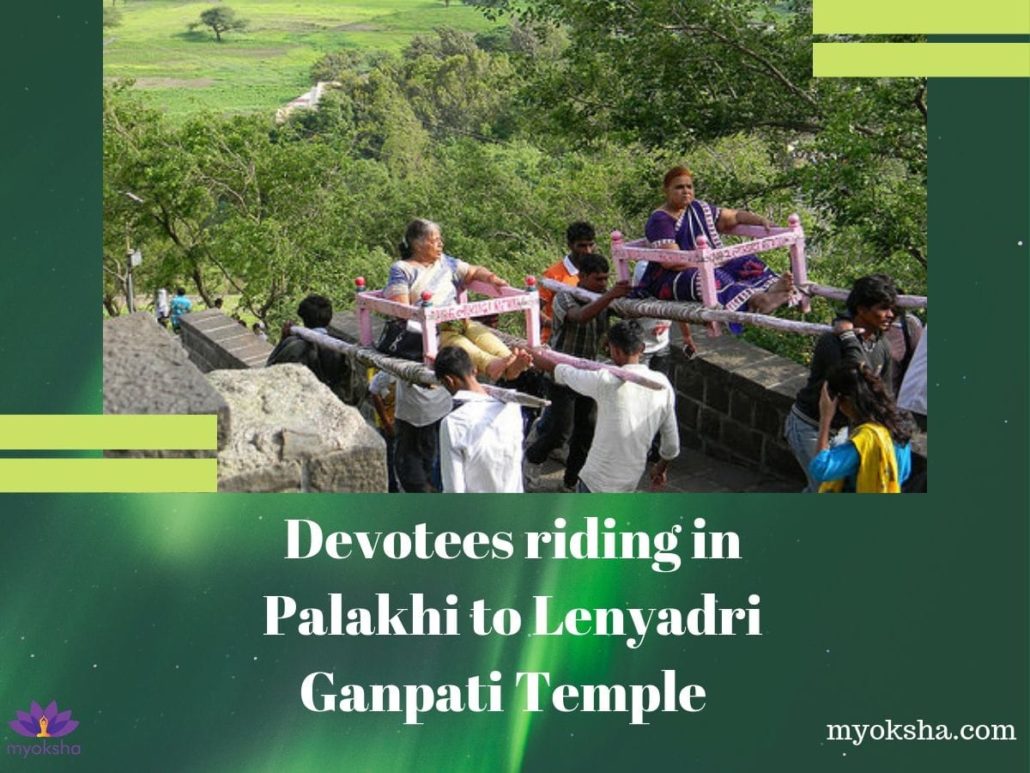
Devotees riding in Palakhi
Many devotees who are unable to walk the 283 steps, take the Palakhi rides to reach Lenyadri Ganpati Temple.

How to reach the Lenyadri Ganpati Temple?

Here’s how to reach Lenyadri Ganapati temple:

  • Road: Lenyadri is nearly 95 km from Pune. Junnar is the nearest town at a 5 km distance. Lenyadri enjoys good roads and several buses operate from Mumbai, Thane, and Pune. The RedBus operates a bus from Mumbai to Junnar in every 15 minutes.
  • Rail: The nearest railway station is at Pune, 94 km from Girijatmaj. Devotees can purchase the Tickets at ₹150 – ₹1,000 and the journey takes 2h 43m.
  • Air: The nearest airport is at Pune, which is well connected to all major Indian cities. There are numerous numbers of taxis and buses that will take you to Pali from outside the airport.

Where to stay near Lenyadri Ganpati Temple?

Yatri Niwas in Lenyadri Temple
Yatri-Niwas in Lenyadri Ganpati Temple for devotees to rest.

Lenyadri Ganpati Temple trust operates Yatri Niwas and offers accommodation at nominal charges.

Temple trust has built Yatri-Niwas for lodging purpose of devotees. At a time arrangement of 300 devotees can be done. Rs.200 are charged for a room having the capacity of 10 people.

  • Beddings are provided by the trust.
  • A very good lunch arrangement is available at Hotel Girija.
  • There are few resorts that function at Junnar.

Lenyadri is name of Temple Trust and it comes in Golegaon. Main crops of this area are Grapes, Tomato, Cacumber and Sugarcane. A very good season for going to Lenyadri is from Diwali to May.

Where to eat near Lenyadri Ganpati Temple

There are no restaurants at Lenyadri except for the Yatri Niwas which offers food options. However, devotees may opt to eat at the smaller restaurants on the highway or at Junnar.

Devotees can also get a meal coupon from the temple office (timing: till 1.30p.m.) for Rs.10/-. 

What are some of the temples and sightseeing places near Lenyadri Ganpati Temple?

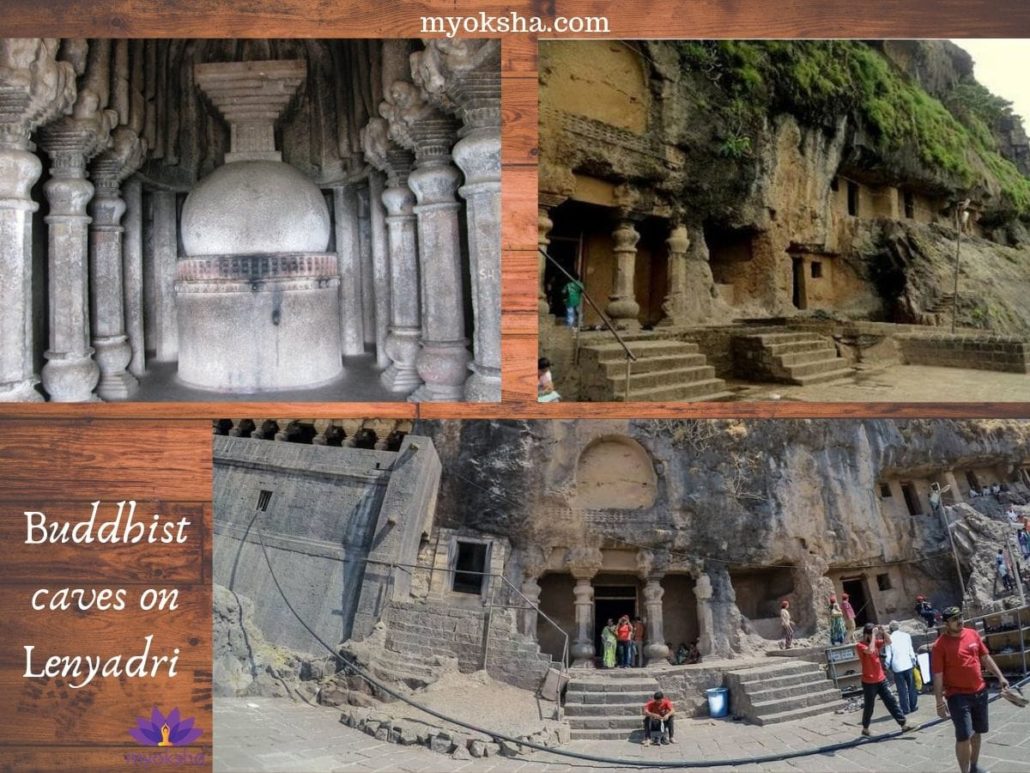
Buddhist caves on Lenyadri
Sightseeing places near Lenyadri Ganpati Temple filled with Buddhist Caves.

Here are some temples near Lenyadri Ganapati Temple:

Lenyadri Buddhist caves: Girijatmaj Temple is amidst a collection of 30 manmade rock-cut caves. These caves have functioned as Buddhist Monasteries from Lord Buddha’s time. Moreover, the seventh cave is the Girijatmaj Temple. However, other caves were either chapels or living spaces for the monks.

Bhima Gada: Adjacent to the Lenyadri Ganpati Temple, cave no. 6 houses a Buddhist stupa. This is popular as Bhima’s Gada. This stupa has good acoustics that allows sounds to echo.

What are the other Ashtavinayak Temples?

Ashtavinayak Temples
Different Idols of Ashtavinayak Temple

Other Ashtavinayak temples are:

  1. Mayureshwar Temple, Morgaon – This is the first of the Ashtavinayak Temples. Devotees begin and end their journey at the Mayureshwar Temple. The temple got its name after the legend of Mayureshwar – Lord Ganesh riding a peacock.
  2. Ballaleshwar Temple, Pali: This temple derives its name from Lord Ganesh’s devotee Ballal. This is the only Ganesh Temple whose name is after a devotee. It is in Pali, 180 km from the Girijatmaj Temple.
  3. Siddhi Vinayak Temple, Siddhatek – This temple is the second in the list of Ashtavinayak Temples. Lord Vishnu is believed to have appeased Lord Ganesh at this place before slaying the demons Madhu and Kaitabh. The Siddhi Vinayak Temple is in Siddhatek, Maharashtra.
  4. Varadha Vinayak Temple, Mahad – This temple is the fourth in the list of Ashtavinayak Temples. Lord Ganesh is famous as Varadha Vinayak, the Lord who grants boons and wishes.
  5. Chintamani Temple, Theur – This temple is the fifth in the list of Ashtavinayak temples. Lord Ganesh retrieved the invaluable jewel – Chintamani from a greedy demon and gave it back to sage Kapila.
  6. Vighneshwar Vinayak Temple, Ozar – This temple is the seventh in the list of Ashtavinayak Temples. Lord Indra sent Vighnasur to disturb King Abhinandan’s prayer. Then, the troubled devotees turned to Lord Ganesh who defeated the demon at this place.
  7. Mahaganapati Temple, Ranjangaon – This is the last of the Ashtavinayak Temples. Lord Shiva worshipped Lord Ganesh here before proceeding to defeat the demon Tripurasura.

Frequently Asked Questions about Lenyadri Ganpati Temple –

Is there online booking available for Lenyadri Ganpati Temple?

Entry to the temple is free and no booking is needed to visit the temple.

What is the nearest airport to Lenyadri Ganpati Temple?

The nearest airports are in Pune at a distance of 95 km.

What is the temperature in Lenyadri Ganpati Temple?

The maximum temperature in summer can reach till 35°C. The minimum temperature that can fall down is 13°C in winter.

What is the significance of Lenyadri Ganpati Temple, among the Ashtavinayak Yatra?

The Lenyadri Ganpati Temple comes in 6th number during the Ashtavinayak Yatra.

What is the prasad’s usually offered in the temple?

Ladoo and Modak prasad which are known to be favorite of Lord Ganesh are offered in the temple.

When are the celebrations celebrated during Lenyadri Ganpati Temple?

The Bhadrapad and Magh Chaturthi are times when big celebrations are held in the temple. In the month of Magh, an Akhand Harinaam Saptah is also held.

Where do devotees pray in the Lenyadri Ganpati Temple?

Devotees can offer prayers in the Garbhagriha of Girijatmaj temple. Flowers, Garlands are the main offerings made at Girijatmaj temple.

What are the sightseeing places near Lenyadri Ganpati Temple?

There is a small garden, namely Sunder Udyan near Bhakta-Niwas. Fort Shivneri, where Chhatrapati Shivaji Maharaj was born is at a distance of 5-6 km’s from Lenyadri.

Chintamani Ganpati Temple – Ashtavinayak Guide – Timings, Poojas and Significance

August 19, 2019, Sasidhar Darla 6 Comments Filed Under: Maharashtra Temples Tagged With: Ashtavinayak Temples, Ganesha Temples

Chintamani Ganpati Temple is dedicated to Lord Ganesha and is one of the eight Ashtavinayak Temples in Maharashtra. The temple is in Theur in Haveli Taluka. Chintamani Ganpati temple has specially designated sections for meditation. The main mandap consists of wood with a stone fountain at its centre.

Planning to visit this temple? Have a look at our Ashtavinayak Yatra Tour Packages.

Chintamani Ganpati Temple – Facts

Deity Lord Ganesha
Location Theur, Maharashtra
Significance Part of Ashtavinayak Temples
Best Time to Visit July – November
Darshan Timings 6:00 AM to 1:00 PM | 2:00 PM to 10:00 PM
Entry Fees Free
Vehicle Parking Fees20 to 30 Rs (As per vehicle)
PhotographyNot Allowed
Dress Code Traditional
Festivals Badrapat, Magh and Rama-Madhav Punyotsav
Few more interesting facts on Chintamani Ganpati Temple at Theur in Maharashtra

Chintamani Ganpati Temple – Timings

The timings of Chintamani Ganapati Temple are:

TimingsFromTo
Morning Darshan6 AM1 PM
Evening Darshan2 PM10 PM
Darshan Timing on Angarkhi Chaturthi 4 AM11 PM
Maha Aarti Timing 7:30 AM
Maha Prasad Timing 10 AM1 PM
Madhyan Aarti Timing 12 PM
Shejaarti Timing 10 PM
  • Notes/Tips: Plan to spend 1-2 hours for darshan. On weekends, the rush will be more. During the festivals of Ganesh Chaturthi and few other Ganesh festivals, devotees have to wait for 3 – 4 hours for darshan.

Donations by devotees on Abhishek, Ekadashi, Sahastravartana, and so forth are done by Priests. Prasad and Angara (wholy fiery remains) are sent by post.

What are the poojas and sevas conducted at Chintamani Ganpati Temple?

Timmings and Pooja Rituals in Chintamani Ganpati Temple
Devotees waiting for the start of the auspicious aartis and rituals in Chintamani Ganpati Temple

Here are the poojas and rituals that take place at Chintamani Ganapati Temple:

Poojas and Rituals
Sahastravartan
Abhishek
Ekadashi

Devotees may make the appropriate payments at the temple and receive the Holy Prasad and ashes of Yagna.

The famous Chintamani Ganpati temple has a separate section known as Overry where devotees can meditate peacefully.

What is the significance of Chintamani Ganpati Temple?

The significance of Chintamani Ganapati Temple is that Lord Chintamani is the God who brings peace mind. The idol of Lord Chintamani faces east. The Lord’s eyes are precious gems. The Mahadwar or the main gate of the temple is north-facing, and a road connects it to river Mula Muth.

There are numerous little temples inside the temple complex like Mahadeva temple. Also, there is additionally a Vishnu-Lakshmi temple and a Hanuman temple. So while doing the temple Parikrama, those temples can be equally viewed. Since the legend of Chintamani occurred under a Kadamba tree, therefore, the village of Theur has another name- Kadambapur.

Lord Chintamani is the family deity of Shree Madhwarao Peshwa. Shree Madhwarao spent his last days at the temple and breathed his last while chanting the Lord’s name. Saint Morya Gosavi did severe penance at Theur. Pleased with his penance, Lord Ganesh emerged from the nearby river Mula Muth as two tigers and granted the saint with Siddhi.

It is beleived that Kapila Muni received this gem through worshipping Lord Shiva at Talaiaalankaadu near Thanjavur in Tamilnadu. Legends says that he walked on his head to reach the shrine.

Significance of Chintamani Ganpati Temple in Theur
One of the many different temples that can be found inside the temple premises while doing the parikrama.

What is the architecture of Chintamani Ganpati Temple?

Architecture of Chintamani Ganesh Temple in Theur
The temple was build in around 18th Century CE during the Peshwa rule and has vivid architectural style.

It is portrayed as one of the largest and increasingly acclaimed of the Ashtavinayak temples. The temple’s entryway situated toward the North is moderately smaller. The central icon of Chintamani Ganpati faces East. The temple has a wooden Sabha-mandapa which was built by Madhavrao. The lobby of the temple additionally has a black stone drinking fountain in it.

There are a number of smaller hallowed shrines in the temple complex. Behind the temple is the Peshwa Wada also known as the Peshwa Palace. Once it was the living arrangement of Madhavrao. Today the everyday activities of the temple are conveyed from this spot.

While there is no definite date of the origin of these places of worship, the present temple was built during the Peshwa rule in the eighteenth century CE.

The fascinating history of Chintamani Ganpati Temple in Theur
The valiant and devoted ruler of the Peshwas Shree Madhwarao Peshwa who constructed the present structure of the temple Chintamani Ganpati.

What is the history of Chintamani Ganpati Temple?

History of the Chintamani Ganapati is that there is no record of the person who built it. However, devotees believe that it exists since ancient times. Also, Chintamani Ganpati is related to the Saint Morya Gosavi, a staunch devotee of Lord Ganesh. Moreover, his descendants constructed the main temple structure.

Following a hundred years, Madhavrao Peshwa raised the Sabhamandap of the temple. A couple of years prior to the Shikhar (peak), of the temple was blessed in gold. As Peshwas visited these spot frequently, the two 5 metal bell purchased from Europe was one kept in Mahad and another one was kept here.

After the passing of Madhav Rao Peshwa, his wife performed Sati, the beautiful garden in the temple was made in her memory.

It is said that Emperor Aurangzeb had offered many grants to this temple. These days the organization of this temple is administered by Chinchwad Temple Trust.

Legends related to Lord Ganpati of Chintamani in Theur
The divine idol of Lord Ganpati at the shrine of Chintamani Temple in Theur.

What are the legends of Chintamani Ganpati Temple?

Legend of Theur: Lord Brahma was once feeling very restless and plagued by an unwavering mind. He then meditated to Lord Ganesh in this village to help him to pacify his restless mind. The name Theur is a derivative of the Sanskrit word – Sthavar, which means stable. Since Lord Ganesh helped clear Lord Brahma’s worries, the Lord became popular as Chintamani Vinayak.

Legend of Chintamani: King Abhijeet and his wife did severe penance and gave birth to Ganaraja, also known as Guna. When Ganaraja visited Sage Kapila’s ashram, the sage took the help of the precious jewel – Chintamani to serve food to the prince. However, the greedy Ganaraja wanted the jewel for himself and forcibly took it from the Sage.

Goddess Durga advised Sage Kapila to seek Lord Ganesh’s help. Then, Lord Ganesh defeated Ganaraja under a Kadamba tree, retrieved the precious jewel and took it back to sage Kapila. So, the sage rewarded Lord Ganesh by putting the jewel around his neck. Henceforth the Lord became famous as Chintamani Vinayak

What are the festivals celebrated at Chintamani Ganpati Temple?

Festivals of Chintamani Ganpati Temple in Theur
The festival of Ganesh Chaturthi celebrated with much pomp and glory in the temple.

Some festivals celebrated at Chintamani Ganapati Temple are:

Bhadrapat: Lord Ganesh’s birth celebrations known as Ganesh Chaturthi or Vinayak Chaturthi is a key festival in the state of Maharashtra. In Theur, Lord Chintamani’s birthday is a big event during Bhadrapat Shudh (August / September)

Magh: The Dwaryatra festival held during Magh Shudh, the Chintamani Ganpati Temple is bustling with arrangements. Devotees celebrate the celebrations in Magh Shudh  until Ashtami, or the eighth day (January – February)

Rama-Madhav Punyotsav: A fair is organized in the month of Karthik by the temple as part of the Rama-Madhav Punnyotsav. This commemorates the death anniversary of the temple patrons Madhavrao and his wife Ramabai.

The town of Theur sits at the conjunction of three noteworthy provincial rivers Mula, Mutha and Bhima, making it a picturesque delight.

How to reach Chintamani Ganpati Temple?

Here’s how to reach Chintamani Ganpati Temple:

  • By road: Theur is nearly 25 km from Pune. Several state-run buses operate from Pune and Mumbai to Theur. In the event you are self-driving you can take Mumbai to Khandala road course. After crossing the Bhor Ghat, the town of Theur can be seen which is situated in Haveli Taluka, Pune District.
  • By rail: The nearest railway station to Theur is in Pune. The Pune station connects to major Indian cities. Pune Junction railroad station associates the city with all the prime Maharashtra cities. There are a few mail/express trains and superfast trains connecting the city from south, north, and west.
  • By air: The nearest airport is at Pune, which connects to all major Indian cities. Lohegaon Airport or Pune Airport is a universal air terminal, found 15 km far from Pune downtown area. Regular flights from Bangalore, Jaipur, Delhi, Goa, Mumbai, Hyderabad, Chennai, and Nagpur lands in the airport. Theur is 22 km from Pune Airport.

Where to stay near Chintamani Ganpati Temple?

There are not many places to stay for accommodation at Theur. Therefore, pilgrims usually consider staying at Pune which is just 25 km from the Temple.

Where to eat near Chintamani Ganpati Temple?

  • There are no restaurants at Lenyadri except for the Yatri Niwas which offer food options.  Therefore, devotees opt to eat at the smaller restaurants on the highway or at Junnar.
  • Moreover, one can consider having lunch inside the temple premises served by the foundation. A small amount of Rs 15 is charged for having Lunch in the temple. In this thali, you get the opportunity to eat rice, dal/lentil, aloo chana curry dish, chappati, and sooji halwa/Sheera.
  • The temple volunteers served the food while you sit in a table and chair. Lunch timing is from 12 to 2 pm.

What are some temples near Chintamani Ganpati Temple?

Bhima Gada: Adjacent to the Girijatmaj Temple, cave no. 6 houses a Buddhist stupa. This is popular as Bhima’s Gada. This stupa has good acoustics that allows sounds to echo.

What are some other Ashtavinayak Temples?

Other Ashtavinayak Templess
The different idols of Lord Ganesh in the other seven temples that come under the Ashtavinayak Yatra

Here’s a list of the other Ashtavinayak Temples:

Mayureshwar Temple, Morgaon: Devotees begin and end their journey at the Mayureshwar Temple. The temple derives its name from the legend of Mayureshwar – Lord Ganesh riding a peacock, who defeated a demon at this place. The Mayureshwar Temple is in Moregaon, 63 km from the Chintamani Temple.

Siddhi Vinayak Temple, Siddhatek: It is believed that Lord Vishnu appeased Lord Ganesh at this place. Lord Vishnu then proceeded to slay the demons known as Madhu and Kaitabh. Moreover, Lord Siddhi Vinayak is the only idol with the trunk pointing towards the right. The Siddhi Vinayak Temple is in Siddhatek, 100 km from the Chintamani Temple.

Ballaleshwar Temple, Pali: As the name suggests this temple is named after Lord Ganesh’s devotee Ballal. This is the only Ganesh Temple whose name is after a devotee. The Ballaleshwar Temple is in Pali, 140 km from the Chintamani Temple.

Varadha Vinayak Temple, Mahad: Lord Ganesh is Varadha Vinayak, the Lord who grants boons and wishes. The Varadha Vinayak Temple is in Mahad, 150 km from the Chintamani.

Girijatmaj Temple, Lenyadri: Goddess Parvathi is believed to have performed penance at this place to have a child. The deities prayers were answered when Lord Ganesh was born. The temple gets its name from the words Girija (Parvathi) and Atmaj (son). The Girijatmaj Temple is in Lenyadri, 110 km from the Chintamani Temple.

Vighneshwar Vinayak Temple, Ozar: King Abhinandan’s prayer was disturbed by Vighnasur, the demon who was sent by Lord Indra. So King Abhinandan sought helped from Lord Ganesh who defeated the demon at this place. The Vighneswar Vinayak Temple is in Ozar, 105 km from the Chintamani.

Mahaganapati Temple, Ranjangaon: To defeat the demon Tripurasura, Lord Shiva is believed to have worshipped Lord Ganesh here. The Mahaganapati Temple is in Ranjangaon, 42 km from the Chintamani.

Frequently Asked Questions about Chintamani Ganpati Temple –

Is there online booking available for Chintamani Ganpati Temple?

Entry to the temple is free and no booking is needed to visit the temple.

Where we can stay near Chintamani Ganpati Temple?

Being 25 km from the temple of Theur, Pune is the best option for lodging.

What is the best mode of transportation from Pune to Theur?

Hiring a Cab or a Uber is the best and fastest mode to reach Theur.

What is the fuel cost of self-drive from Pune to Theur?

The cheapest way to reach Theur from Pune is self-driving where the fuel will cost you around ₹180 – ₹270 for 23 km.

What is the nearest airport to Chintamani Ganpati Temple in Theur?

Lohegaon Airport in Pune is the closest airport to Chintamani Ganpati Temple in Theur.

What is the temperature in Chintamani Ganpati Temple, Theur?

The maximum temperature in summer can reach till 35°C. The minimum temperature that can fall down is 13°C in winter.

What is the significance of Chintamani Ganpati Temple, Theur among the Ashtavinayak Yatra?

The Chintamani Ganpati Temple comes in 5th number during the Ashtavinayak Yatra.

What is the prasad’s usually offered in the temple?

Ladoo and Modak prasad which are known to be favorite of Lord Ganesh are offered in the temple.

Kanipakam Sri Varasiddhi Vinayaka Temple – Timings, Poojas, and Entry Fee

September 13, 2019, Sasidhar Darla 6 Comments Filed Under: Andhra Pradesh Temples Tagged With: Ganesha Temples

Kanipakam Temple is one of the holy abodes of Lord Vinayaka (Ganesha) – the beloved son of Shiva and Parvati. It is present on the banks of river Baahuda, in Chittoor district of Andhra Pradesh. Ganesha is the controller of ‘Ganas’, the remover of obstacles, and the Lord of wisdom. It is usually visited when one is visiting Tirumala Balaji Temple.

Vinayaka Temple is also known as Sri Varasidhi Vinayaka Swamy Temple. 

The word ‘Kanipakam’ originates from two Tamil words – ‘Kani’ meaning ‘wetland’ and ‘Pakam’ meaning ‘flow of water’. The idol of ‘Swayambhu’ Vinayaka is inside ‘Kalyani’, a lake in which the idol was originally found. ‘

It is believed that the main idol of this temple, Lord Vinayaka is self-manifested; hence it is also called with the name of Swayambhu Sri Varasiddhi Vinayaka Swamy Temple.

The Kanipakam temple has Chola architecture, with a simple yet elegant Gopuram for the temple complex that houses temples of two other deities – Sri Manikanteshwara and Sri Varadaraja Swamy.

Kanipakam Sri Varasiddhi Vinayaka Temple – Facts

Deity Lord Vinayaka (Ganesha)
Location Kanipakam Sri Varasiddhi Vinayaka Temple,Kanipakam, Irala Mandal, Chittoor, Andhra Pradesh, 517001, India
Darshan Timings 04:00 A.M.- 09:30 P.M.
Dress Code Traditional Wear
Festivals Brahmostavam, Deepotsava

What are the timings of Kanipakam Sri Varasiddhi Vinayaka Temple?

Here are the timings of Kanipakam Temple:

TimingsFromTo
Morning Darshan4 AM 11 AM
Evening Darshan12 PM9:30 PM

Kanipakam Sri Varasiddhi Vinayaka Temple Entry Fee

PurposeFees
AksharabhyasamRs.116/-
Namakaranam: Rs.116/-
Balasara Rs.116/-
Anna Prasana Anna Prasana
Vahana Pooja Rs.50/- to Rs.150/-
Sashwatha KalyanotsavamRs.5116/-
Sashwatha Unjal Seva Rs.7500/-
Sashwatha Abhishekam Rs.7500/-
Sashwatha Ganapathi HomamRs.7500/-
Sashwatha NityarchanaRs.1516/-
Sashwatha Free Prasadam Rs.1516/-
temple-entry-fee
Kanipakam witnesses huge rush.

Daily Pooja / Sevas Timings of Kanipakam Temple:-

Name of the Seva Timings
Suprabatham & Bindu Teerthabishekam 4:00 AM to 5:05 AM
Palabhishekam 5.45 PM to 6.15 PM
Ganapathi Sahasra Namarchana6.00 AM


Panchamrutha Abhishekam 5.30 AM to 6.00 AM
9.00 AM to 10.00 AM
11.00 AM to 12.00 PM
Ganapathi Homam 9.00 AM to 12.00 PM
Nitya Kalyanotshavam 11.00 AM to 12.00 PM
Ganapathi Modaka Pooja Before 12.00 PM
Phodasa Ganapathi Pooja Before 12.00 PM


Moola Mantraarchana Before 12.00 PM
Unjala Seva 6.30 PM to 7.30 PM
Pavalimpu Seva(EkanthaSev)9.30 PM to 10.00 PM
Nijaroopa Darshan 5.00 AM to 5.30 AM
7.00 AM to 7.30 AM
8.30 AM to 9.00 AM
10.30 AM to 11.00 AM
Athi Seeghra Darshan 5.00 AM to 5.30 AM
7.00 AM to 7.30 AM
8.30 AM to 9.00 AM
10.30 AM to 11.00 AM
4.30 PM to 5.00 PM
Poolangi Seva Thursday Only
daily-pooja
Daily pooja timings are- 04:00 A.M. – 09:30 P.M.

What are the legends of Kanipakam Sri Varasiddhi Vinayaka Temple?

According to the legend behind Sri Vara Siddhi Vinayaka Temple:-

  • There were three brothers, each suffering with one deformity; one was dumb, another deaf and the third one was blind.
  • In spite of the difficulties, they worked on a small piece of land, cultivating it so as to earn their livings.
  • However, one day they when they were trying to get water from well using the Piccota system, they found out that the well had dried up.
  • Hence, one of the brothers started digging the well further. During that process, an iron hit a stone formation. This filled the well with blood.
  • Brothers were shocked with the sight of blood in the well, as they witnessed the sight; their physical disabilities got automatically cured.
  • When the villagers came to know about the miracle, they tried to further deepen the well.
  • In spite of constant trying they couldn’t do it as by then Lord Vinayaka’s idol had self-manifested itself, emerging out of the water of the well.
legends
Self-manifested Lord Vinayaka’s idol
  • It is also believed that the Lord Vinayaka idol at Kanipakam has been growing in size on a daily basis. At present devotees can see up to the abdomen and knees of the Lord Vinayaka.
  • Hence, it is seen that the Lord’s idol has outgrown the armor or Kavacham which was offered about 50 years ago by Smt. Lakshmamma.

What is the history of Kanipakam Sri Varasiddhi Vinayaka Temple?

  • Kanipakam Vinayaka Temple’s history goes back to the 11th century. It is said the temple was built in the 11th century, during the reign of Cholas by the Chola King Kulothunga Chola.
  • Later, the original temple was renovated and expanded further during the Vijayanagara Dynasty in the 13th century.
  • It is built on the banks of River Bahuda, which also has a legend behind it. According to the legend, Sankha and Likhita, two brothers were going to Kanipakam to seek the blessing of the Lord.
  • However, during their journey, the younger brother Likhita, unable to bear his hunger plucked a mango from the mango grove and in spite of his elder brother’s advice ate the fruit.
  • Seeing this, the elder brother informed the King, asking for the rightful punishment to his brother for the sin he had committed.
  • Resultantly, Likhita lost both his hands owing to the punishment given to him. Later, when both the brothers resumed their pilgrimage and went ahead to take a dip in the water of the river near Kanipakam, the younger brother regained both his arms.
  • Since then, the river was named Bahuda, which means the human arm.

What is the significance of the Kanipakam Sri Varasiddhi Vinayaka Temple?

The significance of Kanipakam Temple is that Lord Ganesh is ‘Varasiddhi Vinayaka‘ here because he fulfills the ardent wishes of his devotees when they offer prayers with devotion and sincerity. Also, there are several occasions when a person voluntarily admitted to wrong-doing acts on entering the temple.

This sacred shrine of Kanipakam temple is widely believed to be an upholder of truth and justice. The aura of the Divine Almighty is such that or takes a dip in the holy water. It is as if the Lord evokes a sense of fearful guilty conscience in the mind of the person and makes him genuinely repent for the same.

To this day, the temple solves everyday quarrels between villagers by the two people taking a ‘Pramanam‘ – a special oath in which they take a dip in the Pushkarini and testify before the Lord.

Devotees who wish to give up bad habits like smoking or excessive drinking – take a bath in the holy place and take an oath in the Kanipakam temple by contributing Rs. 516/-. This is a Seva popular as ‘Pramanam’.

What are the festivals celebrated at the Kanipakam Sri Varasiddhi Vinayaka Temple?

Some of the festivals celebrated at Kanipakam Temple are:

  • Brahmostavam: It takes place for a duration of twenty-one days. During the evenings, devotees take the ‘Utsava Moorthi’ into the town in different kinds of colorful Vaahanas (vehicles) on all days – Hamsa Vaahana (Swan), Mayura Vaahana (Peacock), Mooshika Vaahana (Mouse), Shesha Vaahana (Snake), Vrishabha Vaahana (Bull), Gaja Vaahana (Elephant), Pushpa Pallakki (Flowered palanquin), Vimanotsava (Airplane), to name a few.
festival-1
Brahmostavam takes place for a duration of twenty-one days.
  • Deepotsava: It is the celebration involving the floating of lamps in the Kalyani. It is another important festivity and the temple looks magnificent amidst hundreds of floating lamps, under the starry sky.
festival-2
Deepotsava is the celebration involving the floating of lamps in the Kalyani.

How to reach Kanipakam Sri Varasiddhi Vinayaka Temple?

Here’s how to reach Kanipakam Temple:

  • Air – One can avail direct flights to Tirupati from Hyderabad and Chennai only.
  • Rail – Mysore – Tirupati Fast Passenger operates daily, departs Bangalore at 8.15 PM and reaches Chittor at 2.30 AM.
  • Road – Andhra Pradesh State Road Transport Corporation (APSRTC) runs daily buses between Bangalore and Chittoor.

Where to stay nearby Kanipakam Sri Varasiddhi Vinayaka Temple?

The Temple Management runs 6 guest rooms and Tirumala Tirupathi Devasthanams Trust runs the operations of 14 rooms for devotees. Another accommodation complex with 100 rooms is under construction. Besides the Temple accommodation, several private hotels and lodges also provide good quality accommodation to the devotees, in Chittoor city.

What are some temples nearby Kanipakam Sri Varasiddhi Vinayaka Temple?

Some of the temples near Kanipakam Temple are:

  • Manikanteswara Temple: The ancient temple of Manikanteshwara exists since the times of the Chola King Kulothunga Chola. People believe that he built 108 temples of Shiva, to obtain relief from the sin of killing a Brahmin – “Brahma Hatya Papam’. Famous for the Chola architecture, the exquisite sculpture of the idol adds on another striking feature to the divine altar.
  • Varadaraja Swamy Temple: This Kshetram of Lord Ayyappa, also known as Harihara is a landmark in the surroundings, owing to the vast temple compound structure and the architectural marvel in the temple complex, that also houses two other deities – Sri Anjaneya Swamy and the Nava Grahas.
  • Ardhagiri Sri Veeranjaneya Swamy Kshetram – Present at a distance of 15 km from Kanipakam, this holy shrine dates back to Threta Yuga or the times when Lord Rama fought against Ravana the abductor of Sita. Devotees also believe that the Lord fulfills the wishes of those who pray overnight on a full moon night. Cultural programs take place throughout the night for the benefit of the devotees.

Frequently Asked Questions about Kanipakam Sri Varasiddhi Vinayaka Temple

What are the timings of Kanipakam Sri Varasiddhi Vinayaka Temple?

04:00 A.M.- 09:30 P.M. is the timings of the temple.

What is the history of Kanipakam Sri Varasiddhi Vinayaka Temple?

The temple was constructed in the early 11th century CE by the Pandian King Maravarman Sundara Pandian and a Siva temple by Kulothunga Chola I.

If you have any questions about the Kanipakam Temple , please leave a comment below, and we will get back to you within one hour.

  • « Go to Previous Page
  • Page 1
  • Interim pages omitted …
  • Page 49
  • Page 50
  • Page 51
  • Page 52
  • Page 53
  • Interim pages omitted …
  • Page 57
  • Go to Next Page »

Contact Us

Contact Us

  • info@myoksha.com
  • About us
  • Contact us
  • Make a Payment

Terms & Policy

  • Terms of Service
  • Privacy Policy
  • Pricing Policy
  • Cancellation Policy

Copyright © 2026 Myoksha Travels

  • info@myoksha.com
  • About us
  • Contact us
  • Make a Payment